On this page
Building a bilingual Arabic-English website is not just about translating your content. Arabic is a right-to-left (RTL) language with completely different typography conventions, reading patterns, and design aesthetics. A clinic website that handles both languages poorly ends up alienating both audiences.
Q.Why Your UAE Clinic Needs a Bilingual Website
The UAE population is approximately 30% Arabic-speaking nationals and a significant percentage of Arabic-speaking expatriates from Egypt, Jordan, Lebanon, Syria, and other MENA countries. Even though English is widely used, Arabic-speaking patients strongly prefer consuming healthcare information in their native language.
Business case for bilingual websites:
- Reach Arabic-speaking patients who may not find your English-only site
- Build trust with Emirati nationals who prefer Arabic communication
- Improve local SEO — Google serves Arabic results to Arabic-language searches
- Meet DHA and DOH expectations for serving the local population
- Differentiate from competitors who only offer English websites
RTL Design Fundamentals
Layout Mirroring
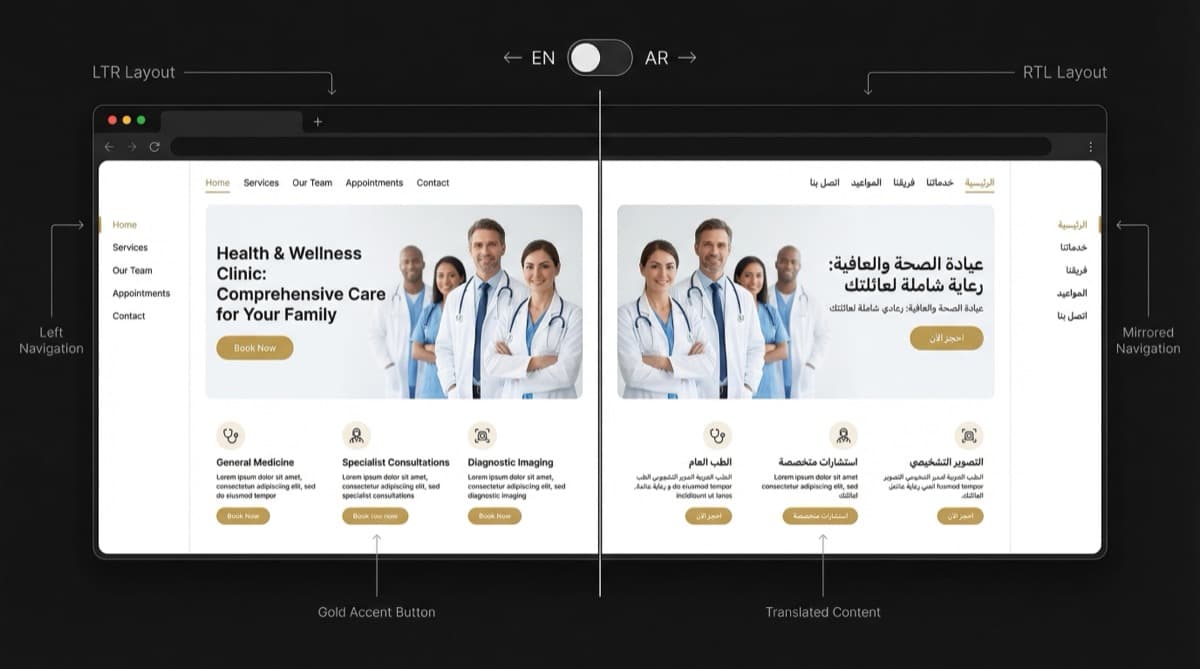
When designing for Arabic, the entire layout must mirror — not just the text direction:
- Navigation menus read right to left
- Sidebars swap from right side to left side
- Image positions may need to flip to maintain visual flow
- Progress indicators and timelines reverse direction
- Icons with directional meaning (arrows, play buttons) must be mirrored
Typography for Arabic Healthcare Websites
Arabic typography requires different treatment than English:
- Font selection — Use professional Arabic fonts like Dubai Font, Noto Sans Arabic, or Tajawal. Never rely on browser defaults
- Font size — Arabic text typically needs to be 10-15% larger than its English equivalent for readability
- Line height — Arabic requires more generous line height (1.8-2.0 vs 1.5-1.6 for English) due to diacritical marks
- Paragraph width — Optimal line length for Arabic is 50-70 characters, similar to English
Common Design Mistakes in Bilingual Clinic Websites
- Machine-translated content — Google Translate produces awkward, unprofessional Arabic that damages credibility. Always use a native Arabic speaker for medical content
- Same layout, swapped text — Arabic layouts need genuine RTL design, not just flipped text
- Mismatched fonts — English heading in Montserrat paired with Arabic in Times New Roman looks disjointed. Choose font pairs intentionally
- Broken forms — Form fields, validation messages, and error states must work in both languages
- Ignored SEO — Arabic pages need their own meta titles, descriptions, and URL structures
Building a Bilingual Healthcare Website
Architecture Options
Option 1: Subdirectory approach (recommended)
- English: futurise.studio/en/services
- Arabic: futurise.studio/ar/services
- Best for SEO, single domain authority, easier to maintain
Option 2: Subdomain approach
- English: en.yourclinic.ae
- Arabic: ar.yourclinic.ae
- Separate from main site, requires separate SEO efforts
Option 3: Language switcher on same URLs
- Single URL with language toggle
- Not recommended — poor for SEO and user experience
Content Strategy for Bilingual Sites
Not all content needs to be translated word-for-word. Adapt your content strategy:
- Core pages (About, Services, Contact, Doctors) — Full translation required
- Blog content — Create some Arabic-original content rather than only translating English posts. Arabic-speaking patients search for different topics and use different keywords
- Treatment pages — Full translation with culturally adapted descriptions
- Patient forms — Must be fully functional in both languages
- Legal pages — Privacy policy and terms must be available in both languages
SEO for Bilingual Healthcare Websites
Each language version needs independent SEO:
- Separate keyword research — Arabic search terms are not direct translations of English keywords
- Hreflang tags — Tell Google which language version to show to which users
- Arabic meta data — Title tags, meta descriptions, and alt text in Arabic for Arabic pages
- Arabic Google Business Profile — Create an Arabic version of your Google Business Profile
- Arabic backlinks — Build links from Arabic healthcare directories and publications
Need help with this?
Our team specializes in healthcare branding. Get personalized advice in a free 15-minute call.
Book a free 15-minute callBilingual Website Cost in the UAE
| Component | Additional Cost for Arabic |
|---|---|
| Design (RTL adaptation) | +30-50% of English design cost |
| Development (RTL implementation) | +40-60% of English development cost |
| Content (translation + adaptation) | AED 0.30-0.80 per word for medical translation |
| SEO (Arabic optimisation) | +50-70% of English SEO retainer |
| Maintenance (ongoing) | +25-35% of English maintenance cost |
FAQ
Q:Should I build the Arabic version first or the English version?
A:Build the English version first, but design with RTL in mind from the start. This means using CSS frameworks that support RTL (like Tailwind CSS with RTL plugins) and structuring your code for easy language switching. Retrofitting RTL support onto an English-only codebase is significantly more expensive.
Q:Do I need a native Arabic speaker for medical content?
A:Yes. Medical content in Arabic must be accurate, professional, and use the correct medical terminology. Machine translation is not suitable for healthcare content — errors in medical terminology can mislead patients and create liability issues.
Q:Which Arabic dialect should I use for my UAE clinic website?
A:Use Modern Standard Arabic (MSA) for your website content. MSA is understood across all Arabic-speaking populations and is considered the professional standard for written healthcare communication. Avoid dialectal Arabic in formal content — it limits your audience and appears less professional.