On this page
The NMC Rule Nobody Understands (And Doctors Exploit Anyway)
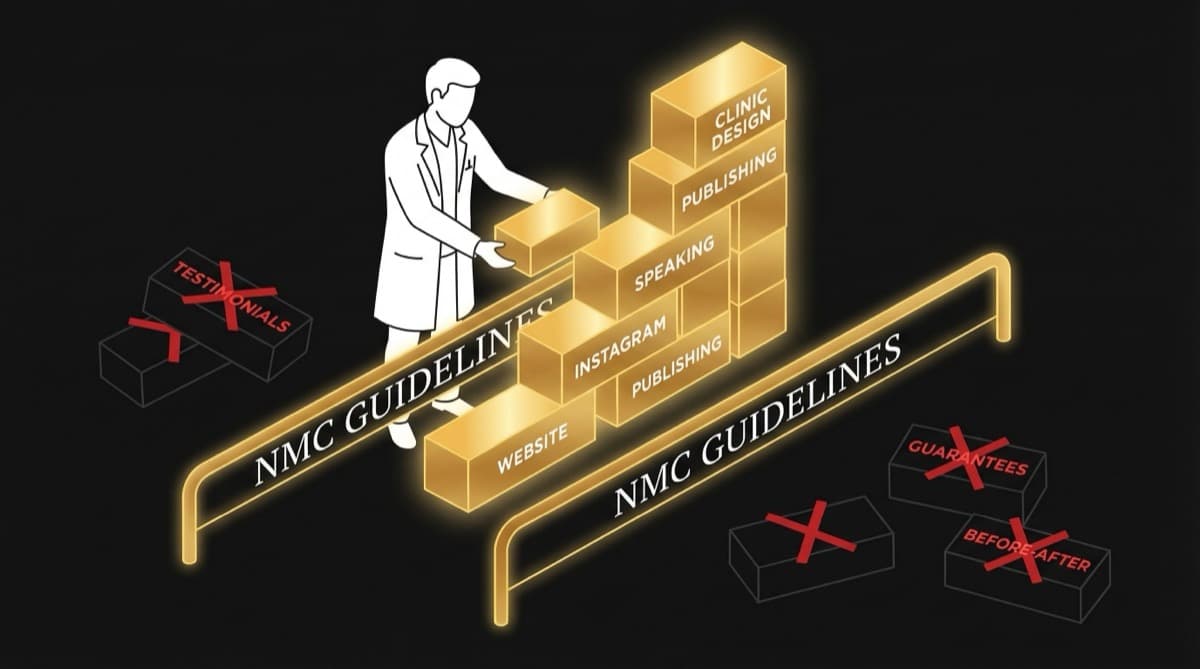
The National Medical Commission allows doctors to build educational thought leadership. It forbids advertising your clinic for profit. Most doctors confuse these and do neither. The ones earning Rs 15-50L from personal brand understand the structural difference: educational content isn't promotion. Teaching is allowed. Selling is what triggers NMC enforcement.
Here's how to build without breaking rules.
Q.How Does Structural Mechanism 1: What NMC Allows vs. Forbids (2026 Interpretation) Work?
| Activity | NMC Status | Monetization Allowed? | Evidence / Source | Income Potential | Risk |
|---|---|---|---|---|---|
| Educational Content (YouTube, blog, podcast) | Allowed | Yes (ads, sponsorships, courses) | NMC Code 3.3 (professional development) | Rs 50K-3L monthly | Low (if truly educational) |
| Thought Leadership / Research (journal articles, case studies) | Allowed | Yes (licensing, IP) | NMC Code 3.2 (professional knowledge) | Rs 30K-2L monthly | Low |
| Patient Education (condition guides, symptom checkers) | Allowed | Yes (ads, sponsorships) | NMC Code 3.4 (public health education) | Rs 20K-1L monthly | Very Low |
| Community Medical Talks (webinars, talks, public health) | Allowed | Limited (sponsorships only, no direct sell) | NMC Code 3.1 (professional conduct) | Rs 10K-50K per event | Low |
| Clinic Promotion via Testimonials | NOT Allowed | No | NMC Code 1.2 (prohibition on patient testimonials in ads) | Violation | High (NMC warning + fine) |
| Before-After Photos (cosmetic, dermatology) | NOT Allowed | No | NMC Code 1.2 (prohibition on before-after media) | Violation | High (NMC action) |
| Claims of Superiority ("Best doctor," "Only one doing X") | NOT Allowed | No | NMC Code 1.3 (prohibition on superiority claims) | Violation | High (NMC enforcement) |
| Direct Clinic Advertising (Google Ads, Facebook ads) | NOT Allowed | No (illegal promotion) | NMC Code 1.1 (prohibition on paid clinic ads) | Violation | High (NMC + platform removal) |
| Endorsements of Products (medicines, supplements) | NOT Allowed | No (unless licensed endorsement) | NMC Code 1.4 (prohibition on product endorsement) | Violation | High |
| Membership Courses (disease management, clinical protocols) | Allowed | Yes (course revenue is educational) | NMC Code 3.2 (professional education) | Rs 50K-5L monthly | Low |
What you're reading: Teaching is legal income. Selling is illegal income. A YouTube video explaining hypertension management with AdSense monetization = legal (education with ad revenue). A YouTube video saying "come to my clinic for hypertension" with a clinic link = illegal (promotion). The structural distinction: if content stands alone without your clinic, it's educational. If content exists to direct patients to your clinic, it's advertising.
Q.What Is Structural Mechanism 2: Safe Content Categories and Income Model?
| Content Category | Format | Monetization Path | Monthly Income (Established) | NMC Risk | Audience Type |
|---|---|---|---|---|---|
| Disease Management Protocols | Blog, YouTube, Podcast | Ads + Course upsell + Sponsorship | Rs 60K-2L | Very Low (educational) | Doctors + Patients |
| Clinical Case Studies | Blog, Case journal, Case series | Licensing + Publication + Sponsorship | Rs 40K-1.5L | Very Low (knowledge sharing) | Doctors |
| Diagnostic Decision-Making | Blog, interactive tool, YouTube series | Ads + Course + Sponsorship | Rs 50K-1.8L | Very Low (educational tool) | Doctors + Patients |
| Specialty Deep-Dives (Cardiology pearls, IM complications) | YouTube, Podcast, Blog | Ads + Course + Sponsorship | Rs 70K-2.2L | Low (peer education) | Doctors |
| Patient Education (What is diabetes, thyroid myths) | YouTube, blog, social | Ads + Sponsorship (no direct sell) | Rs 30K-1L | Very Low (public health) | Patients |
| Research Summaries (Journal club, latest guidelines) | Blog, newsletter, Podcast | Sponsorship + Subscription | Rs 40K-1.2L | Very Low (knowledge dissemination) | Doctors |
| Telemedicine Content (how to consult remotely, tips) | Blog, video, guide | Ads + Sponsorship | Rs 20K-80K | Low (informational) | Patients |
| Professional Development (exam prep, specialization guides) | Courses, webinars, guides | Course sales only | Rs 1.5L-5L | Very Low (professional education) | Doctors |
What this means: Disease management protocols (explaining diabetic neuropathy) are safe and scalable (Rs 60K-2L). Clinic-directed content ("My clinic treats diabetic neuropathy better") is not. Case studies explaining your clinical decision-making are legal. Testimonials from patients saying "Dr. X saved my life" are illegal. The income gap exists because safe content scales (millions of viewers) while testimonials don't (limited to your patient base).
Q.What Is Structural Mechanism 3: Building Audience While Staying Compliant?
| Growth Stage | Timeline | Content Strategy | Monetization | Monthly Income | Compliance Checkpoints |
|---|---|---|---|---|---|
| Phase 1: Foundation (0-6 months) | 3 videos/week | Educational disease management only; no clinic mention | None (build audience first) | Rs 0 (investment phase) | Ensure content educational, no testimonials, no before-afters |
| Phase 2: Monetization (6-12 months) | 2-3 videos/week | Add research summaries + clinical case analysis | YouTube AdSense + Sponsorships | Rs 20K-60K | Monitor comments (remove patient testimonials); no promotional language |
| Phase 3: Scale (12-18 months) | 2 videos/week + 1 blog/week | Add membership course; case study series | Ads + Sponsorships + Course sales | Rs 80K-1.5L | Ensure course content is educational methodology, not "come to clinic" |
| Phase 4: Authority (18-24 months) | 1-2 videos/week + regular blog + newsletter | Authority content (research, guidelines, specialization deep-dives) | All above + Consulting + Expert advisory | Rs 1.5L-3L | Maintain strict separation: brand = personal authority, clinic = separate entity |
Reading this: The first 6 months you invest (Rs 0 income) to build audience and establish that you produce educational content (NMC compliance). Months 6-12 you monetize with low-friction revenue (ads, sponsorships). Months 12-24 you scale with products (courses, membership) and consulting. The structural rule: compliance comes first, monetization follows. Doctors who try to monetize immediately (clinic ads, testimonials) get flagged early.
Need help with this?
Our team specializes in healthcare branding. Get personalized advice in a free 15-minute call.
Book a free 15-minute callQ.What Is Structural Mechanism 4: Brand Separation Strategy (Critical for Compliance)?
| Element | Personal Brand | Clinic Brand | Why Separation Matters |
|---|---|---|---|
| Domain | yourname.com (personal blog) | clinicclinic.com (clinic website) | Legally separate entities prevent "using personal brand to promote clinic" argument |
| Social Handles | @drname_education, @drname_content | @clinicname, @clinicname_official | Audience follows personal brand; clinic brand is separate funnel |
| Content Focus | Educational, research, teaching, thought leadership | Patient information, clinic updates, appointments | Clear content distinction prevents NMC "advertising clinic via content" claim |
| Monetization | Personal: YouTube, sponsorships, courses, consulting | Clinic: patient revenue only | Income sources separate—clinic isn't funding your personal brand (avoids perception of self-promotion funding) |
| Team | Solo or content team (writers, videographers) | Clinic team (staff, nurses, associates) | Different teams = different entities legally |
| Audience | Doctors, patients, healthcare professionals (broad) | Your clinic patients + referrers (narrow) | Personal brand reaches beyond your clinic; clinic brand is local market only |
What this means: If your YouTube channel is called "Dr. Sharma's Cardiac Pearls," your clinic website should NOT be "Dr. Sharma Clinic." Your clinic website should be "Sharma Cardiac Care" or "Sharma Heart Center." This legal separation prevents NMC saying "you're using educational channel to promote clinic." The monetization is different: YouTube earns you Rs 1-3L (personal brand revenue). Clinic earns you Rs 8-15L (patient revenue). They don't mix.
Q.How Does Structural Mechanism 5: Content That's Safe vs. Red-Flag Content Work?
| Safe Content (Zero Risk) | Red-Flag Content (NMC Risk) | Why It's a Problem |
|---|---|---|
| "How to manage atrial fibrillation: evidence-based protocol" | "Patients in my clinic: AFib management results" | Patient outcome data tied to your clinic = clinic advertising |
| "5 mistakes doctors make in diabetic diagnosis" | "Patients at my clinic rarely miss diabetic diagnosis" | Superiority claim + clinic tying = advertising |
| "Case study: 45-year old with MI and unusual presentation" (anonymized, no clinic name) | "Case from my clinic: 45-year old with unusual MI" | Clinic attribution = promotional case study |
| "Guidelines on hypertensive emergency management" | "How I treat hypertensive emergencies" | Personalizing treatment to drive clinic reputation = advertising |
| "Diagnosing heart murmurs: physical exam pearls" | "At my clinic, I diagnose murmurs with 98% accuracy" (testimonial-like claim) | Superiority claim + clinic tying = false advertising |
| "Subscribe for weekly cardiac updates" | "Call my clinic for cardiac consultations (subscribe to my email)" | Direct clinic call-to-action = clinic advertising |
| "Featured in Journal of Cardiology for research on AFib" | "My clinic's AFib outcomes featured in Journal of Cardiology" | Clinic self-promotion = advertising |
Reading this: Safe content teaches methodology without tying results to your clinic. Red-flag content ties clinical outcomes to your clinic (which implies superiority and functions as clinic advertising). The line is thin: explaining how you diagnose AFib is safe. Saying "I diagnose AFib better at my clinic" is not. Most doctors cross this line accidentally by including clinic attribution in case studies.
Frequently Asked Questions
Q: Can I mention my clinic name anywhere in my content?
A: Yes, in disclaimers and bio sections only. Your YouTube channel description can say "Dr. X practices at Clinic Y, Mumbai." Your video cannot say "at my clinic, we use this method." Your blog bio can link to your clinic website. Your blog content cannot say "my clinic patients benefit from this." The rule: clinic mention is allowed in metadata (description, bio, footer), not in content itself. Metadata is informational; content mention is promotional.
Q: What about a "contact me for consulting" link in my content?
A: Safe only if it's consulting (non-patient, knowledge-based). A link saying "hire me as an advisor for your startup" is fine. A link saying "book a consultation with me at my clinic" is advertising. The distinction: consulting is selling expertise; clinic consultation is selling clinical service. If your content is about clinical management and your link is "book an appointment," that's advertising. If your content is about healthcare innovation and your link is "hire me to advise your healthtech," that's not advertising (it's consulting).
Q: Can I create a membership course teaching my clinic's protocols?
A: Yes, but don't call it "my clinic's protocols." Call it "Advanced Cardiac Management: Evidence-Based Protocols" and teach the methodology. If other doctors could replicate the exact protocols at their clinics, you're educational. If the protocol is unique to your clinic and designed to make patients come to you, it's advertising. The structural rule: if the course teaches methodology that scales to other doctors' clinics, it's educational. If the course teaches you why to come to your clinic, it's clinic advertising (not allowed).
Q: Do I need NMC approval before launching a YouTube channel?
A: No, you don't need pre-approval. But you should self-audit your content against NMC guidelines before posting. NMC doesn't pre-approve; it post-penalizes (complaints lead to investigations). The best approach: document that your content is educational, keep clinic mentions out of content, avoid testimonials and before-afters, don't make superiority claims. If NMC complains, you have documented evidence that your content is educational, not promotional.
Q: What happens if I get reported to NMC for violations?
A: NMC initiates a complaint investigation. If found in violation, outcomes include: warning letter (first-time), suspension of registration for 3-6 months, or fine (Rs 5-25L depending on violation severity). Most first-time violations result in a warning. Repeated violations lead to suspension. The worst case (unethical conduct conviction) is lifetime removal from medical register, but this is rare for content violations. The risk is low if you're compliant, high if you're using testimonials or before-afters. Most doctors don't get reported if their content is clearly educational.
Q: Should I hire a lawyer to review my content?
A: Not necessary if you follow the rules (no testimonials, no before-afters, no superiority claims, clinic mentions in metadata only). If you're in high-risk content (cosmetic procedures, sensitive specialties, testimonial-heavy), get a lawyer to review your compliance quarterly. Cost is Rs 10-20K per quarter for compliance review. Most doctors skip this and stay compliant by following basic rules.
Looking to build a professional healthcare brand? Explore our services at futurise.studio/services or book a free discovery call at futurise.studio/contact