On this page
Every medical practice reaches a point where its brand no longer reflects the quality of care it provides. Maybe your logo was designed by a friend in 2012. Maybe you have expanded into new services but your brand still screams "small family clinic." Maybe you merged with another practice and now have two identities competing for attention.
A medical practice rebrand is a significant investment — but when done correctly, it delivers measurable returns in patient acquisition, retention, and revenue. This guide covers when to rebrand, how to manage the process, and what it costs.
Q.When Should a Medical Practice Rebrand?
Not every practice that wants a rebrand actually needs one. Here are the situations where rebranding delivers a genuine return on investment:
Definite Rebrand Triggers
- Practice merger or acquisition — Two brands competing under one roof creates confusion
- Expansion to new specialties or services — A "Family Medicine" brand does not work for a practice now offering med spa services and concierge care
- Relocation to a significantly different market — Moving from a suburban to an urban location may require repositioning
- Outdated visual identity — If your logo looks like it was designed before smartphones existed, patients notice
- Negative reputation — If your practice name is associated with a previous provider or negative events, a fresh start may be necessary
- Provider transition — When a founding physician retires and the practice continues under new leadership
Situations Where Rebranding Is NOT the Answer
- You have low patient volume (the problem is likely marketing, not branding)
- You are bored with your current look (not a business reason)
- A competitor rebranded (do not chase competitors)
- You have internal disagreements about the logo color (this is not about personal preference)
The Medical Practice Rebrand Process
Phase 1: Strategy and Discovery (Weeks 1-2)
Before designing anything, answer these strategic questions:
- Who is our target patient, and has that changed?
- What do we want patients to feel when they encounter our brand?
- How are we different from competitors in our market?
- What services do we want to be known for going forward?
- Are we keeping our name or changing it?
Name change considerations:
Changing your practice name is a major decision with SEO, legal, and patient communication implications. Keep your name if it still works. Change it if:
- The name contains a former provider's name who has left
- The name limits your positioning (e.g., "[City] Family Medicine" when you now offer orthopedics, aesthetics, and concierge care)
- The name has negative associations
Phase 2: Brand Identity Design (Weeks 3-6)
This is where the visual brand comes together:
- 1Logo design — 3-5 concepts, refined to a final mark with variations
- 2Color palette — Primary, secondary, and accent colors with accessibility testing
- 3Typography — Heading and body font pairings
- 4Brand guidelines — Comprehensive document covering usage rules
- 5Collateral design — Business cards, letterhead, forms, signage specifications
- 6Digital templates — Social media, email headers, presentation templates
Phase 3: Website Redesign (Weeks 4-8, can overlap with Phase 2)
Your website is typically the largest component of a rebrand:
- New design reflecting the updated brand identity
- Updated content and messaging
- SEO migration plan (critical — do not lose your search rankings)
- Provider photos and bios
- Updated service pages and patient resources
- Online booking integration
Phase 4: Physical Rollout (Weeks 6-12)
Updating physical assets takes the longest:
- Exterior and interior signage
- Staff uniforms and name badges
- Patient forms and printed materials
- Prescription pads and referral forms
- Vehicle wraps (if applicable)
- Office decor and environmental branding
Phase 5: Launch and Communication (Week 8+)
A rebrand launch should be an event, not a surprise:
- Announce the rebrand to existing patients via email and letter 2-4 weeks before launch
- Post on social media with a "reveal" campaign
- Send press releases to local media
- Host an open house or patient appreciation event
- Update all online directories, insurance listings, and referral partners
Q.How to Rebrand Without Losing Patients
The biggest risk in rebranding is confusing or alienating existing patients. Mitigate this risk:
- Communicate early and often — Tell patients what is changing and why
- Emphasize what is NOT changing — "Same doctors, same care, same location — with a brand that matches the quality you already experience"
- Redirect old web URLs — Set up 301 redirects from old URLs to new ones
- Keep your phone number — Do not change your phone number during a rebrand
- Update Google Business Profile gradually — Change the name, then update photos and descriptions over the following weeks (sudden changes can trigger Google verification issues)
- Personally call your top referral sources — Let them know about the change before they are surprised
Need help with this?
Our team specializes in healthcare branding. Get personalized advice in a free 15-minute call.
Book a free 15-minute callSEO Considerations During a Rebrand
A rebrand can destroy your search rankings if not handled carefully:
- 301 redirect every old URL to its new equivalent
- Maintain your Google Business Profile — Do not create a new one; update the existing one
- Keep your domain if possible — Changing domains is the highest-risk SEO action
- If you must change domains — Set up comprehensive redirects and expect 3-6 months of ranking fluctuation
- Update all citations (Healthgrades, Zocdoc, Yelp, directories) within the first week
- Maintain existing content — Do not delete blog posts or service pages that drive organic traffic
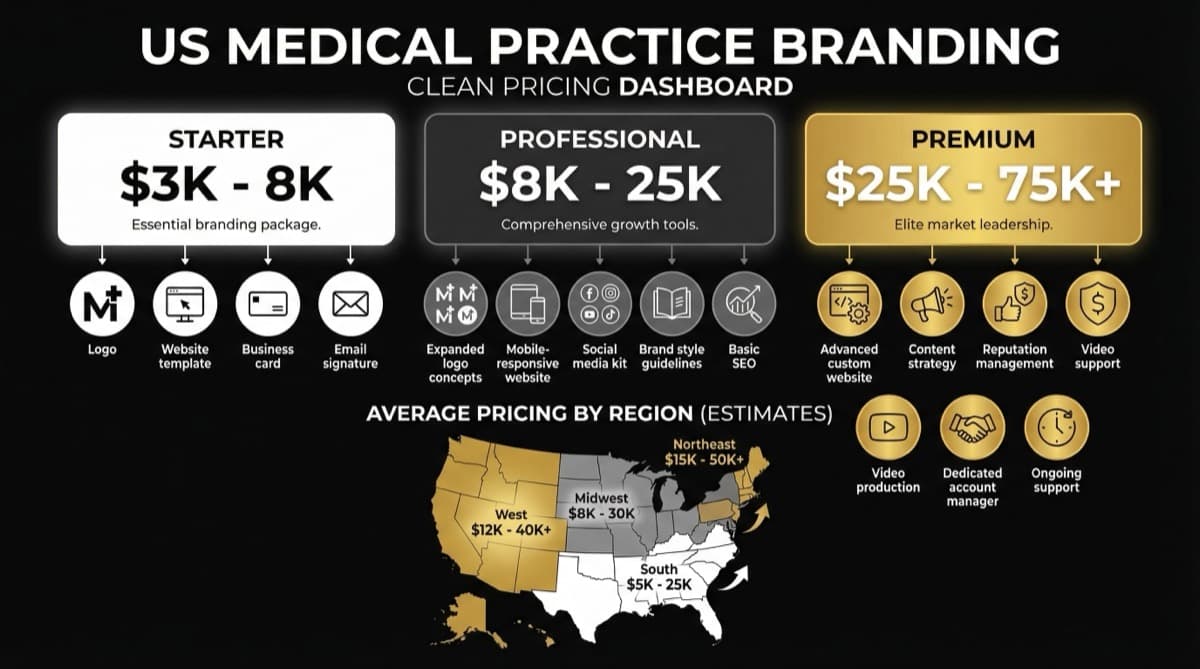
Q.What Does a Medical Practice Rebrand Cost?
| Component | Cost Range | Timeline |
|---|---|---|
| Brand strategy and naming | $3,000-$8,000 | 2-3 weeks |
| Logo and brand identity | $5,000-$15,000 | 3-5 weeks |
| Website redesign | $8,000-$20,000 | 4-8 weeks |
| Signage (design + fabrication) | $5,000-$30,000 | 4-12 weeks |
| Print materials | $1,000-$3,000 | 1-2 weeks |
| Digital templates | $1,000-$3,000 | 1 week |
| Photography | $1,500-$4,000 | 1 day |
| Total | $24,500-$83,000 | 8-16 weeks |
For a solo practice doing a visual refresh (new logo, website, basic materials) without a name change, expect $15,000-$30,000. For a multi-location group doing a comprehensive rebrand with name change, the investment can reach $50,000-$100,000+.
FAQ
Q:How long does a medical practice rebrand take?
A:complete rebrand from strategy to launch typically takes 3-4 months. Simple visual refreshes can be completed in 6-8 weeks. Complex rebrands involving name changes, multi-location rollouts, and regulatory updates can take 6-12 months.
Q:Will a rebrand hurt my SEO?
A:It does not have to, but it can if handled poorly. The key is comprehensive URL redirects, maintaining your Google Business Profile, and updating all online citations within the first week. If you are changing domain names, expect temporary ranking fluctuation for 3-6 months.
Q:Should I rebrand all at once or in phases?
A:All at once is strongly recommended. A phased rebrand creates a period where patients see two different identities — old signage with a new website, or new business cards with an old logo on the building. This inconsistency undermines the entire purpose of rebranding. Set a launch date and update everything simultaneously.
Q:How do I choose between a brand refresh and a full rebrand?
A:refresh updates your visual identity while keeping the same name, positioning, and overall brand feel. A full rebrand changes the name, positioning, visual identity, and sometimes the target market. Most established practices need a refresh, not a full rebrand. A full rebrand is reserved for mergers, major strategic shifts, and practices with damaged reputations.