On this page
AI won't replace doctors — but doctors who use AI will replace those who don't. That's not a comforting platitude. It's a structural prediction based on what AI can already do across medical specialties, and the trajectory is accelerating faster than most practitioners realise.
After fielding this question from 300+ doctors in our DMs, here's the most honest analysis we can give.
Q.Which Medical Specialties Will AI Impact First?
Not all specialties face equal disruption. AI's impact is determined by two factors: how pattern-dependent the work is, and how much of it requires physical human presence. Here's the current landscape:
| Specialty | AI Impact Level | Timeline | Primary AI Application |
|---|---|---|---|
| Radiology | Very High | Already happening | Image interpretation, anomaly detection |
| Pathology | Very High | 2024-2028 | Slide analysis, cancer grading |
| Dermatology | High | 2025-2029 | Visual diagnosis from images |
| Ophthalmology | High | 2024-2028 | Retinal scan analysis, glaucoma detection |
| Cardiology | Moderate-High | 2026-2030 | ECG interpretation, risk prediction |
| Primary Care | Moderate | 2027-2032 | Triage, chronic disease management |
| Psychiatry | Low-Moderate | 2030+ | Screening tools, therapy chatbots |
| Surgery | Low | 2035+ | Robotic assistance, not replacement |
| Emergency Medicine | Low | 2035+ | Decision support, not replacement |
The Pattern Recognition Divide
AI excels at pattern recognition in structured data — images, lab values, ECG tracings. It struggles with unstructured problems that require physical examination, complex patient communication, and multi-system clinical reasoning.
This means: if your job is primarily reading images or interpreting test results, AI will handle that task faster and more accurately within 5 years. If your job requires touching patients, managing emotions, and making judgment calls in ambiguous situations, AI will be a tool, not a replacement.
Q.What Can AI Already Do in Medicine?
The capabilities are more advanced than most doctors realise:
Diagnosis
- Google's Med-PaLM 2 scored 86.5% on US Medical Licensing Exam questions — above the passing threshold
- AI diagnostic tools for diabetic retinopathy have achieved 97% sensitivity and 98% specificity — exceeding average ophthalmologist performance
- PathAI's system can grade prostate cancer biopsies with concordance rates above 90% with expert pathologists
Imaging
- AI radiology tools can read chest X-rays in under 3 seconds with accuracy matching senior radiologists
- Mammography AI (like Lunit INSIGHT) reduces false negatives by 40% compared to single-reader interpretation
- AI can detect early-stage lung nodules on CT scans that human radiologists miss 25-30% of the time
Treatment Planning
- AI-driven clinical decision support systems can recommend treatment protocols based on patient-specific data across thousands of similar cases
- Drug interaction checkers powered by AI have prevented an estimated 1.3 million adverse drug events in US hospitals in 2024-2025
Administrative
- AI scribes (like Abridge, Nabla) can generate clinical notes from doctor-patient conversations in real-time
- Scheduling optimization, insurance pre-authorisation, and billing coding — AI handles these at 10x human speed
Q.What Can't AI Do in Medicine?
Understanding AI's limitations is just as important:
- 1Physical examination: AI cannot palpate an abdomen, listen to breath sounds with context, or perform a neurological exam. Telemedicine has limits; physical diagnosis doesn't
- 2Complex communication: Telling a patient they have cancer, managing family dynamics around treatment decisions, navigating cultural sensitivities — these require human empathy and judgment
- 3Novel situations: AI is trained on historical data. Truly novel presentations, rare diseases, and atypical patient responses require human clinical reasoning
- 4Ethical judgment: Should a 95-year-old with metastatic cancer get aggressive treatment? These are human decisions, not algorithmic ones
- 5Trust and relationships: Patients don't heal through data — they heal through trust. A study in JAMA showed that patients who trust their doctor have 19% better outcomes for chronic conditions. AI doesn't build trust
Need help with this?
Our team specializes in healthcare branding. Get personalized advice in a free 15-minute call.
Book a free 15-minute callQ.What's the Realistic Timeline for AI Impact?
Phase 1: AI as Assistant (2024-2028)
AI tools augment doctor workflow. AI reads the scan first, the radiologist reviews and confirms. AI suggests diagnoses, the clinician decides. This is happening now.
Phase 2: AI as First-Line (2028-2033)
For specific, well-defined tasks, AI becomes the primary performer with human oversight. AI reads all mammograms; radiologists review only flagged cases. AI manages routine chronic disease follow-ups; doctors handle escalations.
Phase 3: AI-Led Care Pathways (2033-2040)
For certain conditions, AI manages the entire care pathway — from diagnosis through treatment monitoring — with doctors involved only at decision points requiring human judgment.
Phase 4: AI-First Healthcare (2040+)
The healthcare system reorganises around AI capabilities. Doctor roles shift fundamentally from diagnosis and treatment to oversight, complex decision-making, and patient relationship management.
Q.How Should Doctors Prepare for AI?
The doctors who will thrive are the ones who start adapting now:
- Learn to use AI tools: Become proficient with AI diagnostic aids, clinical decision support systems, and AI-powered documentation. Being AI-literate is becoming as important as being computer-literate was in 2000
- Double down on human skills: Communication, empathy, complex reasoning, procedural skills — invest in the things AI can't replicate
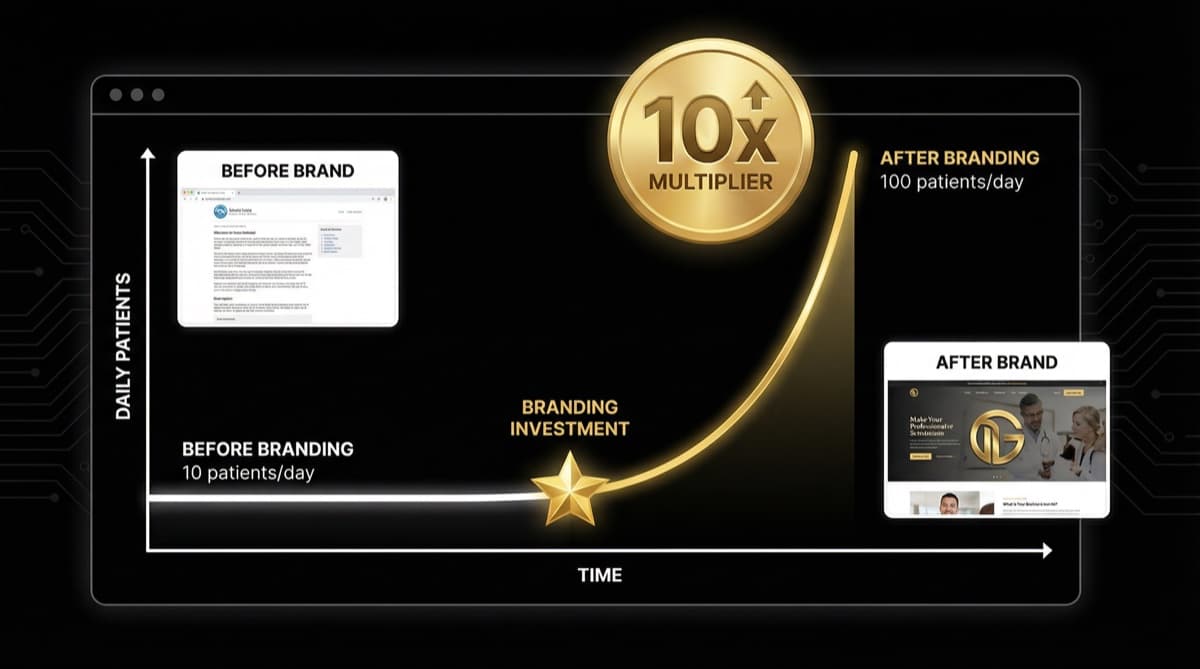
- Build a personal brand: AI can replicate clinical knowledge, but it cannot replicate trust. Patients choose doctors they know, like, and trust — and branding is how you build that at scale
- Specialise in complexity: Move toward clinical work that requires multi-system reasoning, not pattern recognition. The generalist who can connect dots across specialties becomes more valuable, not less
- Stay financially independent: Doctors who own their practice and patient relationships are less vulnerable than those employed by systems that might replace human labour with AI
FAQ
Q:Will AI make certain medical specialties obsolete?
A:No specialty will become fully obsolete, but job descriptions will change dramatically. Radiology won't disappear — but a department that employed 10 radiologists might need 4, with AI handling routine reads. The key is that AI changes the volume of humans needed, not whether humans are needed at all.
Q:Should medical students avoid radiology and pathology?
A:Not necessarily — but they should go in with open eyes. These specialties will increasingly involve AI oversight and quality assurance rather than primary image interpretation. The radiologists of 2035 will spend more time on interventional procedures and complex case interpretation, less on reading routine scans.
Q:How does AI affect doctor income potential?
A:AI will create a bifurcation. Doctors who leverage AI to see more patients, deliver better outcomes, and build efficiency will earn more. Doctors who compete with AI on tasks AI does better will see downward pressure on income. The premium shifts from "what you know" to "how you apply judgment."
Q:Is personal branding really a defence against AI disruption?
A:Yes — and it's one of the strongest defences available. AI can replicate clinical knowledge but cannot replicate a trusted personal brand. When patients can get diagnostic information from AI, the reason they choose a specific doctor becomes trust, reputation, and relationship — all brand assets.