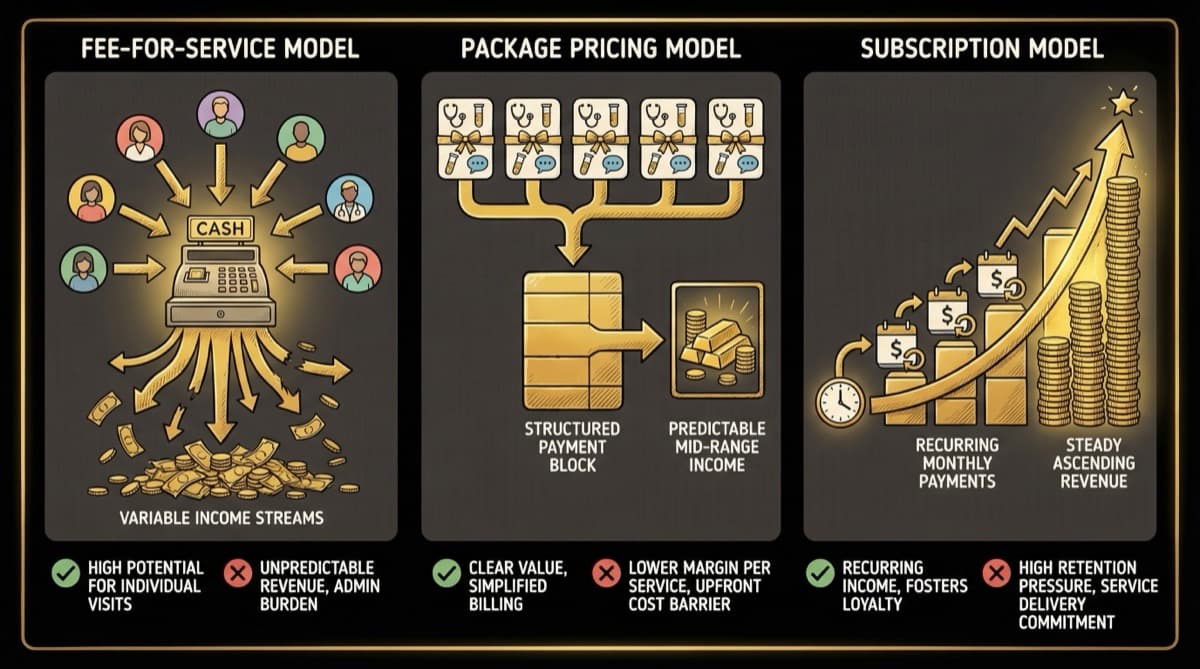
Indian clinics operate on three fundamental revenue models, and each one structurally shapes your income, workload, and patient relationships differently. Fee-for-service rewards volume (more patients, more money). Package-based pricing rewards efficiency (more procedures at standardized rates). Subscription models reward retention (patients pay monthly, you provide ongoing care). Most doctors default to fee-for-service because it's what they've seen — but understanding all three models helps you choose the structure that matches your specialty, capacity, and financial goals.
How Does the Fee-for-Service Revenue Model Work?
Fee-for-service is the most traditional and widely used model. How It Works You charge separately for each service: consultation fee, procedure fee, investigation charges, follow-up fees. Every patient interaction generates a distinct billing event.
Revenue Structure OPD Consultation | Rs 300-1,500 | Per visit Follow-up consultation | Rs 200-800 | Per visit Minor procedure | Rs 1,000-5,000 | As needed Major procedure | Rs 5,000-50,000 | As needed Investigation (in-house) | Rs 200-2,000 | Per test
Structural Advantages
- Income scales with effort. Work more, earn more. No ceiling on daily income
- Simple accounting. Each service has a price. Revenue = services × price
- Patient expects value per visit. Each interaction is a transaction — clear expectations
- Works for all specialties. Universal model that any clinic can implement
Structural Disadvantages
- Income requires physical presence. You don't earn when you're not seeing patients. Vacation = zero income
- Volume pressure. The financial incentive is always to see more patients, which can compromise consultation quality
- No recurring revenue. Every month starts at zero. You're only as good as this month's patient count
- Insurance compression. When insurance sets package rates, your FFS pricing gets overridden
Best For General practice, specialty consultations, surgical practices, any clinic where patient visits are episodic rather than continuous.
How Does Package-Based Pricing Work for Clinics?
Package pricing bundles multiple services into a single price. How It Works You bundle services into standardized packages. A "Diabetes Management Package" includes initial consultation + 4 follow-ups + 2 HbA1c tests + diet counseling for Rs 5,000. A "Maternity Package" includes all antenatal visits + delivery + postnatal care for Rs 50,000-1.5 lakhs.
Revenue Structure Health check package | Rs 1,500-10,000 | Consultation + tests + report | One-time Chronic disease management | Rs 3,000-8,000 | Consultation + follow-ups + tests | 6-12 months Maternity package | Rs 50,000-1.5 lakhs | Full antenatal + delivery + postnatal | 9-12 months Dental treatment package | Rs 10,000-1 lakh | Complete treatment plan | As needed Surgical package | Rs 20,000-5 lakhs | Surgery + hospital stay + follow-up | Episode-based Cosmetic procedure package | Rs 15,000-3 lakhs | Multiple sessions + follow-up | 3-6 months
Structural Advantages
- Predictable revenue. You know what each patient is worth upfront
- Higher per-patient value. Packages typically generate more total revenue per patient than individual FFS visits
- Patient commitment. Once a patient buys a package, they're invested in completing it
- Insurance alignment. Insurance companies increasingly prefer package-based pricing — your model aligns with the payer
Structural Disadvantages
- Efficiency pressure. The package price is fixed, so every extra minute or resource spent on a patient reduces your margin
- Complexity risk. Patients whose conditions are more complex than the package anticipates cost you more without generating more revenue
- Pricing challenges. Set packages too low, you lose money on complex cases. Set them too high, patients choose FFS competitors
- Refund management. If a patient doesn't complete the package, refund policies become contentious
Best For Chronic disease management (diabetes, hypertension clinics), maternity care, dental practices, cosmetic procedures, and any specialty where treatment follows predictable pathways.
How Does the Subscription or Retainer Revenue Model Work?
Subscription models provide recurring revenue through fixed periodic payments. How It Works Patients pay a fixed monthly or annual fee for ongoing access to healthcare services. A "Primary Care Subscription" at Rs 500-2,000/month covers unlimited consultations, basic tests, and priority appointments.
Revenue Structure Basic Primary Care | Rs 500-1,000 | Unlimited consultations + 2 basic tests/year | Rs 6,000-12,000 Premium Primary Care | Rs 1,500-3,000 | Consultations + tests + home visits + teleconsultation | Rs 18,000-36,000 Chronic Disease Management | Rs 1,000-2,500 | Specialist consultations + monitoring + medication guidance | Rs 12,000-30,000 Family Health Plan | Rs 2,000-5,000 | Coverage for 4 family members, all services | Rs 24,000-60,000 Corporate Employee Health | Rs 500-1,500/employee | OPD consultations + wellness + health checks | Rs 6,000-18,000/employee
Structural Advantages
- Recurring revenue. Most powerful financial model — revenue comes in whether patients visit or not
- Predictable cash flow. Monthly income is stable regardless of daily footfall fluctuation
- Patient retention. Subscribers are locked in. They don't shop for another doctor each time
- Preventive orientation. Financial incentive shifts from treating illness (FFS) to preventing it (subscription)
- Lower acquisition cost. One patient acquisition generates 12+ months of revenue instead of one visit
Structural Disadvantages
- Overuse risk. Some patients may visit excessively, consuming more resources than their subscription covers
- Scaling challenges. If 200 subscribers all need appointments in the same week, capacity becomes a bottleneck
- Market education needed. Indian patients are accustomed to pay-per-visit. Subscription requires explanation and trust-building
- Regulatory uncertainty. Subscription healthcare models have regulatory grey areas in India — they must not resemble insurance products (which require IRDAI licensing)
- Churn risk. If patients don't perceive value, they cancel. Retention requires continuous engagement
Best For Primary care / family medicine, chronic disease management, corporate health services, wellness clinics, and any specialty with ongoing patient relationships rather than episodic care.
How Should You Choose the Right Revenue Model for Your Clinic?
Your specialty and patient relationship type determine the best fit. Episodic visits (acute care, surgery) | Fee-for-Service | Each visit is a distinct clinical event Predictable treatment pathways (dental, cosmetic) | Package | Outcomes are standardized, pricing can be fixed Ongoing patient relationships (chronic disease, primary care) | Subscription | Long-term relationships generate recurring revenue Mixed (some acute, some chronic) | Hybrid (FFS + subscription option) | Give patients choice based on their needs
The Hybrid Approach
Most successful clinics in India use a hybrid model:
- FFS for walk-ins and new patients — captures one-time demand
- Packages for defined treatment plans — maximizes per-patient value
- Subscription for loyal patients — locks in recurring revenue
The mix evolves as your practice matures: early on, FFS dominates (you need volume). As patient relationships develop, packages and subscriptions grow as a share of revenue.
Frequently Asked Questions
Which revenue model pays the most? Subscription generates the most predictable revenue but requires scale (200+ subscribers). Package pricing generates the highest per-patient revenue. FFS generates the most immediate revenue. The highest-earning clinics typically combine all three.
Can I switch revenue models after opening? Yes — in fact, most clinics evolve their model over time. Starting with FFS (lowest barrier to entry), adding packages as you identify common treatment pathways, and introducing subscriptions for loyal patients is a natural progression.
Do Indian patients accept subscription models? Increasingly, yes — particularly in urban areas and among younger patients familiar with subscription services in other industries. Corporate health subscriptions have gained significant traction. Individual patient subscriptions require trust-building and clear value communication.
How do I price my packages? Calculate the total FFS cost if the patient paid for each service individually. Discount by 10-20%. This gives the patient a clear savings incentive while maintaining your margin. Test pricing with a small group before rolling out broadly.
Is subscription healthcare legal in India? Yes, but with caveats. Subscription models that provide healthcare services are generally permissible. However, models that promise financial coverage for hospitalization may cross into insurance territory requiring IRDAI regulation. Consult a healthcare lawyer to ensure your model is structured correctly.
Planning to launch your clinic? A strong brand identity is your foundation. See our Brand Sprint package at futurise.studio/services or view our portfolio at futurise.studio/portfolio