On this page
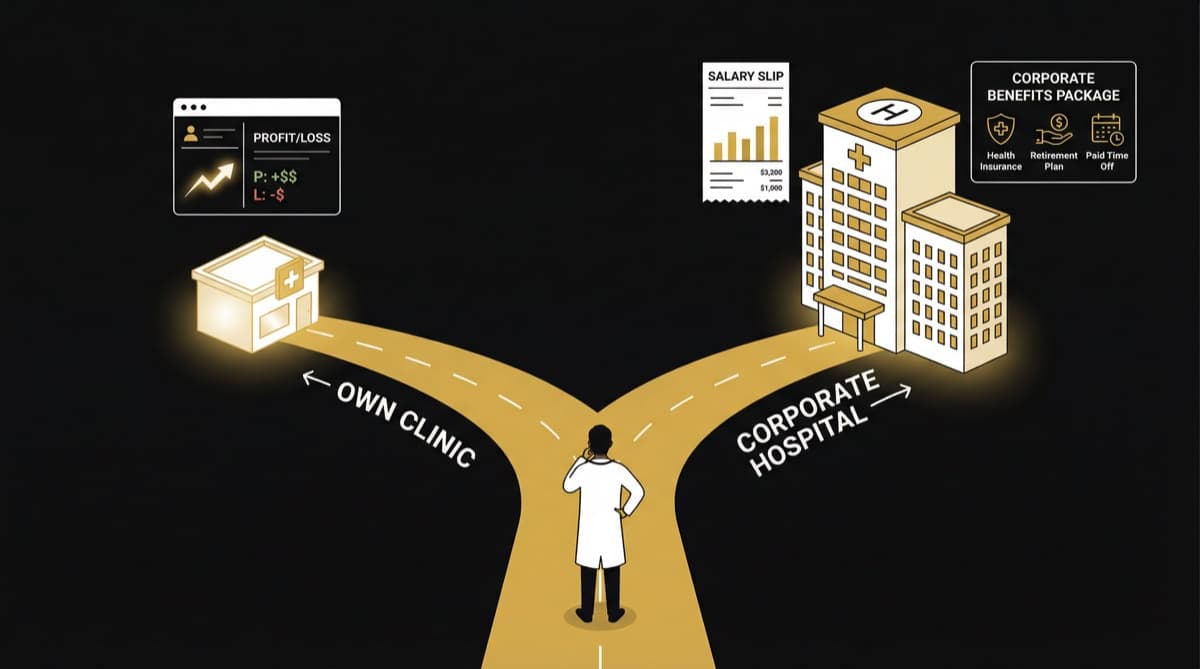
Choose a location where: (1) foot traffic is 500+ people/day within 500m, (2) rent is 25-30% of gross revenue, (3) diagnostic chains are within 1-2 km (your patient will go there anyway), (4) parking exists (underrated factor), and (5) catchment area income is 80,000+ monthly per household. Most doctors choose location based on convenience or ego. This costs Rs 20-40 lakh in avoidable losses.
The Location Economics: Why Most Doctors Choose Wrong
You're looking for clinic space. You find three options:
Option A: Ground floor, busy market area, Rs 1 lakh/month rent. Option B: 2nd floor, residential area, Rs 60,000/month rent. Option C: 3rd floor office complex, Rs 40,000/month rent.
Most doctors choose B or C for lower rent. This is a mistake.
Option A (ground floor, market): 1,000/day foot traffic, 2% conversion, 20 daily patients, 600 monthly, Rs 30-45 lakh revenue. Option B (2nd floor, residential): 50/day foot traffic, 3% conversion, 1.5 daily patients, 45 monthly, Rs 2.5-3.5 lakh revenue. Option C (3rd floor office): 100/day foot traffic, 3% conversion, 3 daily patients, 90 monthly, Rs 4.5-6 lakh revenue.
Option A makes 6x more profit than Option B despite 1.67x higher rent. This is why location matters more than clinical skill for practice economics.
Q.What Is Foot Traffic Rule: 500+ People Per Day?
For a medical clinic to be viable, it needs minimum 500 people walking past per day. With 2% conversion (500 people, 10 daily appointments), you get 300 patients per month. This fills your appointment slots and covers rent + staff + utilities.
Below 500 daily foot traffic, you'll rely on appointment referrals instead of walk-ins. You hit a ceiling at 100-150 patients/month.
How to measure foot traffic: Visit location at 9 AM, 12 PM, 3 PM, 6 PM (4 days). Count people walking past in 30-minute intervals. Multiply average by 16 (8 hours operating) for daily estimate. If 500+, location is viable. If under 300, location will struggle.
Q.What Is Rent-to-Revenue Ratio: Don't Go Above 30%?
Rent should be 25-30% of gross monthly revenue or less.
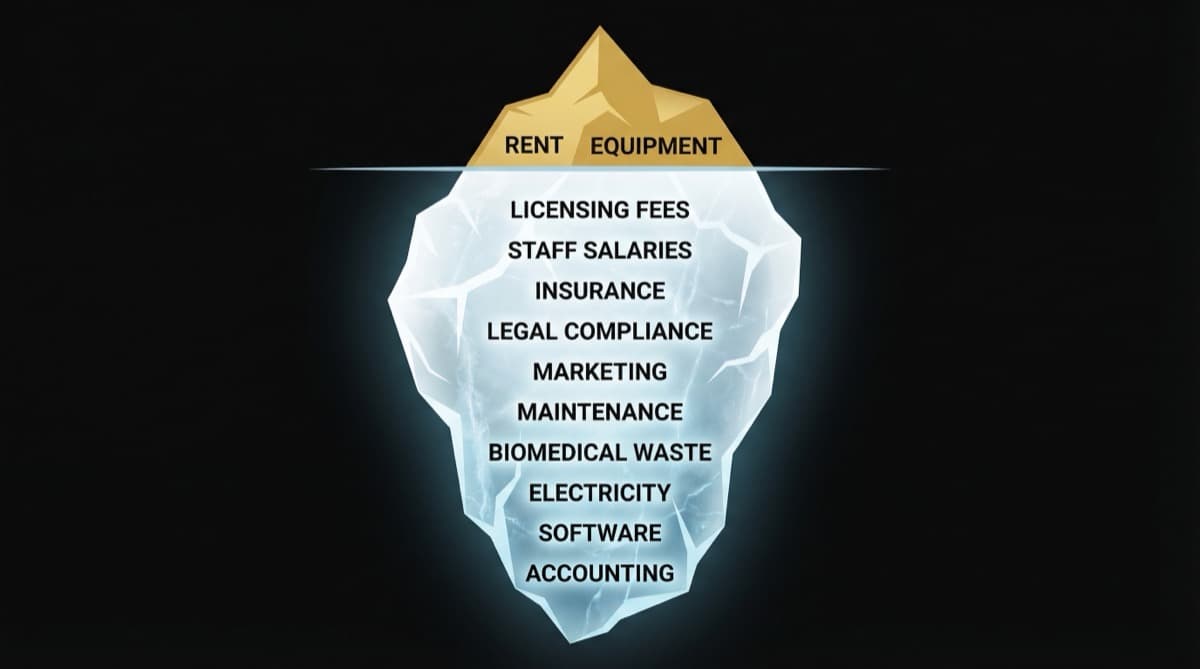
Clinic expense breakdown (typical): Rent 25-30%, Staff 20-25%, Utilities 3-5%, Consumables 3-5%, Marketing 2-3%, Doctor's take-home 30-40%.
If rent exceeds 30%, you're forced to cut staff, utilities, consumables, marketing, or your own income.
The rent trap: Many doctors sign 5-year rent agreements at rates they think are "temporary." Rent increases 10-15% every 2 years by lease clause. By year 5, rent is 50%+ higher. Never sign a long lease. Negotiate 2-year terms with annual rent increases capped at 5%.
Q.What Is the Catchment Area Analysis?
Your clinic's patients come from a catchment area. For general practice: 85% within 1 km. For specialist: 75% within 3 km. For super-specialist: 60% within 10 km.
Catchment area criteria:
Income level: Average household income at least Rs 80,000/month. Below this, patient conversion is poor.
Residential vs. Commercial balance: 60-40 residential-commercial split is ideal. Pure residential limits foot traffic. Pure commercial means high rent.
Healthcare density: 1-2 km to nearest diagnostic chain. Your patients will use labs. Proximity within 500m of a major diagnostic chain adds 30% patient walk-ins.
Parking availability: 10-15 parking spots within 100m. If patient can't find parking, they don't come back.
Accessibility: Auto/taxi/bus stop within 100m. Not all patients have cars.
Need help with this?
Our team specializes in healthcare branding. Get personalized advice in a free 15-minute call.
Book a free 15-minute callQ.How Does The Diagnostic Chain Proximity Rule Work?
Patient journey (2026): Lab then Doctor then Treatment.
Patient thinks: "I got my test done at Thyrocare. Now I need a doctor to interpret. Who's nearby?" If there's a clinic 100m from the lab, patient walks there. If 2 km away, patient Googles a closer option.
Within 500m of major diagnostic chain: +30% patient walk-ins. Within 1 km: +15% walk-ins. 2+ km away: No proximity benefit.
Q.What Is the Capital Requirement?
Typical costs: Rent deposit Rs 2-4.5 lakh. Interior fit-out Rs 3-5 lakh. Equipment Rs 5-10 lakh. Furniture Rs 1-2 lakh. Signage + branding Rs 50,000-1 lakh. Legal Rs 20,000-50,000. Total capital needed: Rs 12-23 lakh.
Don't borrow this capital. Save it first. Taking debt for location setup is risky because if location underperforms, you can't escape the lease.
Frequently Asked Questions
Q: Is location more important than my clinical skills?
A: For patient acquisition, yes. For patient retention and satisfaction, no. You need both. But a mediocre doctor in an excellent location will outperform an excellent doctor in a terrible location.
Q: How long before my clinic breaks even at a new location?
A: 8-12 months typically. If it takes more than 18 months, location is probably wrong.
Q: What's the worst location mistake doctors make?
A: Choosing location based on personal convenience ("I live nearby") instead of patient foot traffic. This limits growth permanently.
Your clinic's success is determined 70% by location, 30% by clinical skill. Choose location scientifically.
Planning to launch your clinic? A strong brand identity is your foundation. See our Brand Sprint package at futurise.studio/services or view our portfolio at futurise.studio/portfolio