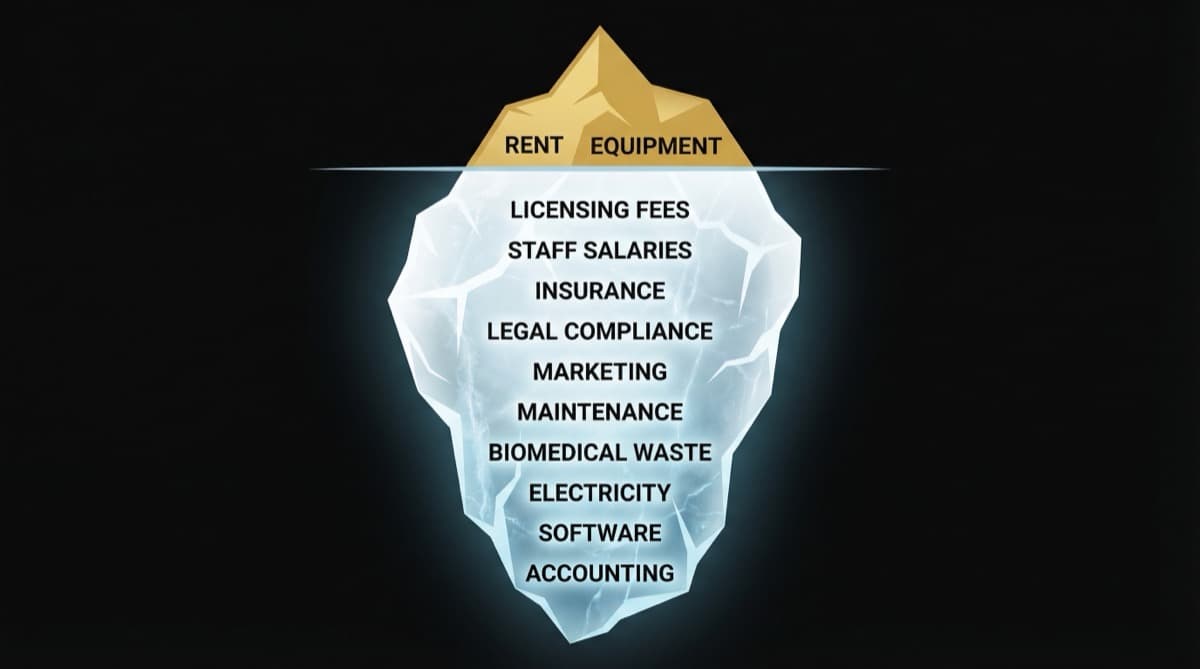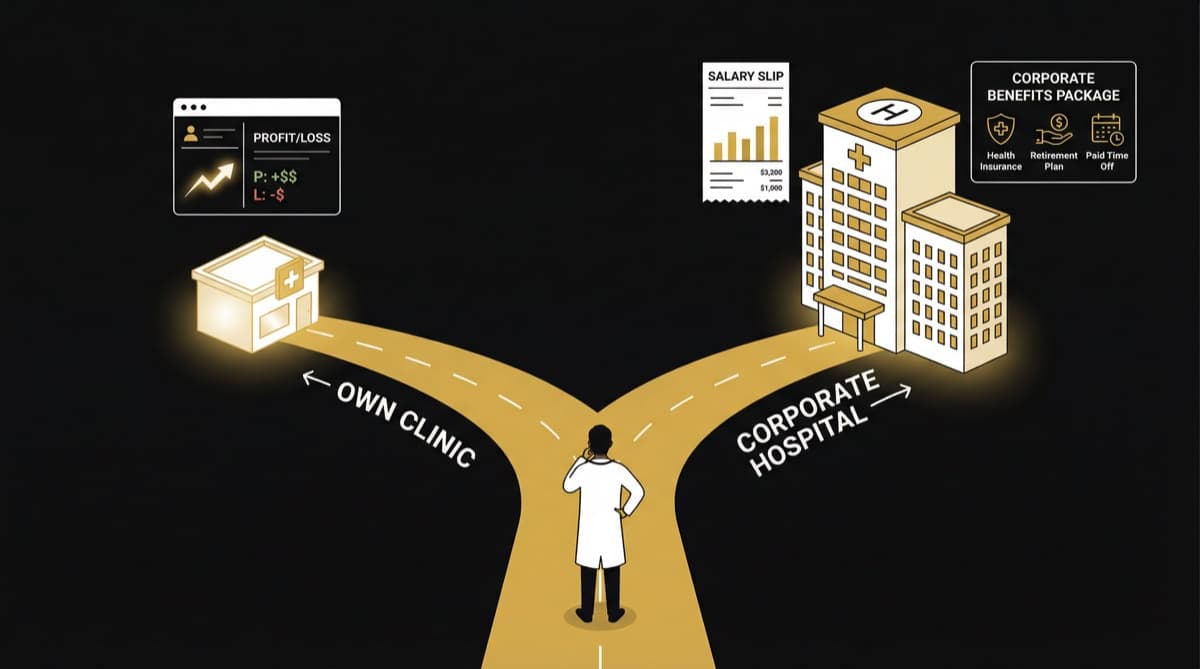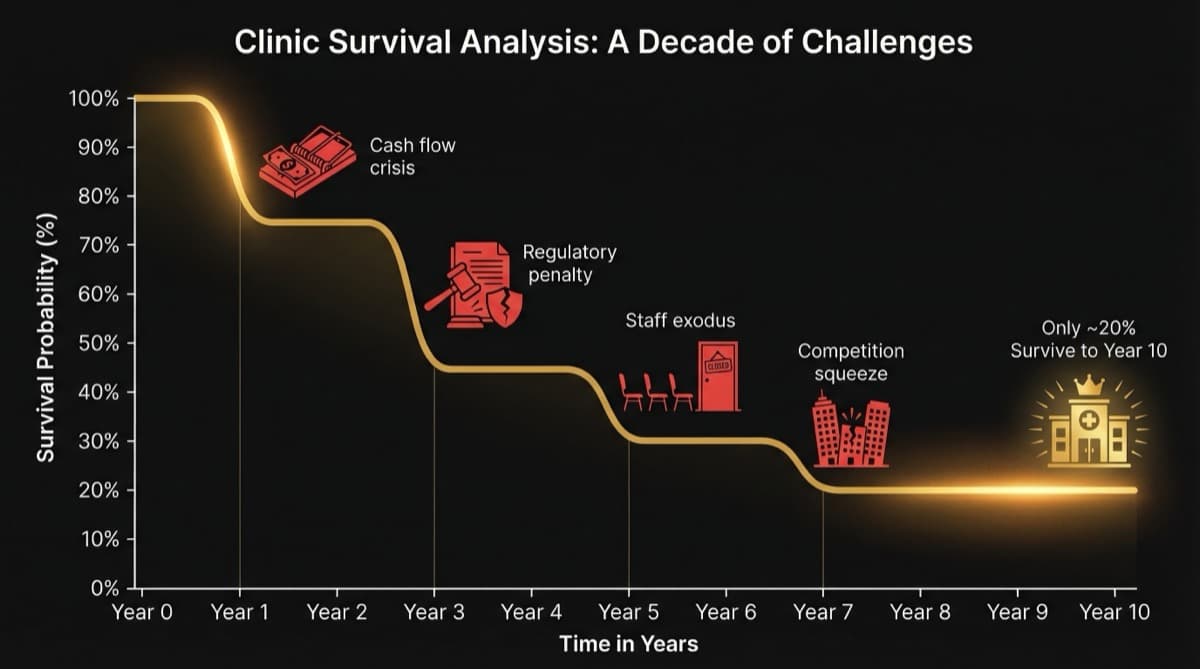
Approximately 25-30% of new medical clinics in India fail within their first 3 years — not because the doctors are clinically incompetent, but because they fall into structural financial traps that medical training never prepared them for. The four deadliest traps: rent-to-revenue ratio above 30%, undercapitalization (insufficient working capital for the 18-month cash flow gap), choosing a location without footfall data, and EMI timing mismatch (equipment payments starting before patient volume justifies them). Each of these is predictable, preventable, and structurally independent of clinical skill.
What Are the Four Structural Traps That Kill New Clinics?
Four predictable financial traps cause most clinic failures. Trap 1: Rent-to-Revenue Ratio Above 30%
The mechanism: You sign a lease at Rs 75,000/month because the location "feels right" — good area, nice building, near a main road. After 12 months, your revenue is Rs 2 lakhs/month. Your rent is 37.5% of revenue. After rent escalation (10-15% annually), it's headed toward 40%+.
Why it kills: Rent is the largest fixed cost and the hardest to change. You can't renegotiate a lease easily. You can't move without losing patients. And every month the ratio stays above 30%, you're transferring wealth from your practice to your landlord.
The data: Clinics with rent-to-revenue ratios below 25% have the highest 3-year survival rates. Above 35%, the failure rate exceeds 50%.
How to avoid it: Calculate the minimum monthly revenue your specialty can realistically generate in months 12-18. Multiply by 0.25. That's your maximum rent. If the location you want costs more, find a different location — no matter how tempting.
Trap 2: Undercapitalization
The mechanism: You budget Rs 30 lakhs for clinic setup — and spend exactly that on lease deposit, renovation, equipment, and furniture. You open with Rs 0 in working capital. Month 1 revenue: Rs 50,000. Month 1 costs: Rs 2 lakhs. You're Rs 1.5 lakhs short. By month 6, you've borrowed Rs 9 lakhs on personal credit at 18-24% interest.
Why it kills: High-interest borrowing during the cash flow gap creates a debt spiral. Each month of loss adds to the debt. Interest compounds. By month 12, even if patient volume is growing, you're servicing credit card debt and personal loans on top of clinic costs. The clinic becomes a liability rather than an asset.
How to avoid it: Budget 2x your setup cost. If your clinic costs Rs 30 lakhs to build, you need Rs 30 lakhs in working capital. Total capital requirement: Rs 60 lakhs. If you can't access this amount, start smaller or delay until you can.
Trap 3: Location Without Footfall Data
The mechanism: You choose a location because it's in a "good area" — meaning your friends live there or the building is new. You don't measure actual foot traffic, parking availability, visibility from the road, competitor density, or the demographic profile of the catchment area.
Why it kills: A clinic on the 3rd floor of a building on a side street has structurally different patient acquisition than a ground-floor clinic on a main road. A clinic in a residential area with 50% retirees has different demand than one near an office complex. Location determines patient volume more than clinical skill, marketing, or reputation.
How to avoid it: Before signing a lease, spend 3 days counting foot traffic at different times. Check Google Maps for competitor clinics within 1 km radius. Assess parking availability. Talk to existing shopkeepers about daily footfall patterns. This Rs 0 investment of 3 days can save Rs 30 lakhs of wasted setup cost.
Trap 4: EMI Timing Mismatch
The mechanism: You buy a laser machine (Rs 20 lakhs) and an ultrasound unit (Rs 12 lakhs) on finance. EMIs: Rs 55,000/month. These start within 30-60 days of delivery — not 30-60 days after your first patient. For the first 6-12 months, these EMIs are a pure cost with inadequate matching revenue.
Why it kills: Equipment EMIs are contractual obligations. Missing payments damages your credit rating and risks equipment repossession. The financial pressure to "use the equipment to generate revenue" can lead to over-investigation of patients — which is both ethically wrong and unsustainable if patients catch on.
How to avoid it: Start with minimum essential equipment. Lease instead of buying where possible (leases can be structured with deferred or graduated payments). For expensive equipment, negotiate EMI moratoriums of 6-12 months to align payments with expected revenue ramp-up. Only purchase equipment when patient volume justifies the investment.
What Does the Timeline of Clinic Failure Look Like?
Clinic failure follows a predictable trajectory. Month 0-3 | Setup costs exceed budget. Revenue far below projections. Enthusiasm high | Use working capital. Don't panic. Track metrics Month 4-6 | Revenue growing slowly. Savings depleting. First doubts | Adjust strategy: extend hours, increase visibility, build referrals Month 7-12 | Critical zone. Either patient volume is growing or it's not. Cash reserves running low | If on track: hold steady. If not: cut costs aggressively or exit before losses deepen Month 13-18 | Revenue should approach break-even. If not, structural problem exists | Evaluate: location wrong? Rent too high? Specialty mismatch? Honest assessment needed Month 19-24 | Either profitable and growing, or losses accelerating | Profitable: reinvest carefully. Losing: consider exit. Don't throw good money after bad Month 25-36 | Established practices strengthen. Failing ones finally close | Survival past 36 months with positive cash flow = structural viability confirmed
What Are the Five Warning Signs Your Clinic Is Heading for Failure?
Watch for these indicators that signal structural problems. 1. Rent exceeds 35% of revenue after month 12 — location economics are structurally unfavorable
- 1Patient volume isn't growing month-over-month — demand doesn't exist or you're not capturing it
- 2You're borrowing at high interest to cover operating costs — the debt spiral has started
- 3Equipment utilization is below 30% — you bought capacity you don't need yet
- 4You're considering unethical practices to generate revenue — over-investigation, unnecessary procedures, or commission arrangements signal desperation
What Do Successful Clinics Do Differently?
Successful clinics follow a consistent pattern of financial discipline. They start small. One room, minimal equipment, low rent. Add capacity as demand proves it.
They choose location by data, not feeling. Footfall counts, competitor mapping, demographic analysis.
They underspend on fitout and overspend on working capital. A basic-looking clinic with 24 months of cash reserves survives. A beautiful clinic with 3 months of cash doesn't.
They build patient volume before buying equipment. Start with consultation-only. Add procedures when you're seeing 15-20 patients/day consistently.
They have alternative income during the build phase. Hospital sessions, freelance work, or spousal income that covers personal expenses while the clinic covers its own costs.
Frequently Asked Questions
What percentage of clinics fail in India? Approximately 25-30% of new medical clinics close within 3 years. The primary causes are financial (rent burden, undercapitalization) rather than clinical (poor medical care). Most failed clinics were run by competent doctors who underestimated the business challenge.
What's the most common reason clinics fail? Undercapitalization — not having enough working capital to survive the 18-month cash flow gap between opening and break-even. Doctors budget for setup costs but not for the months of losses during patient volume building.
Can I save a failing clinic? Sometimes. If the problem is operational (poor marketing, wrong hours, weak referral network), it's fixable. If the problem is structural (rent too high for the location's catchment, wrong specialty for the demographic), it may be cheaper to close and restart in a better location than to keep losing money.
How much should I save before opening a clinic? Total clinic setup cost × 2. If your clinic costs Rs 30 lakhs to build, save Rs 60 lakhs total — Rs 30 lakhs for setup and Rs 30 lakhs for working capital. This gives you 18-24 months of runway.
Is it better to fail fast or try to save a struggling clinic? Fail fast. Every month of losses above your planned runway adds to unrecoverable debt. If after 18 months your clinic shows no trajectory toward break-even, closing preserves capital for your next attempt — which will benefit from everything you learned.
Planning to launch your clinic? A strong brand identity is your foundation. See our Brand Sprint package at futurise.studio/services or view our portfolio at futurise.studio/portfolio