On this page
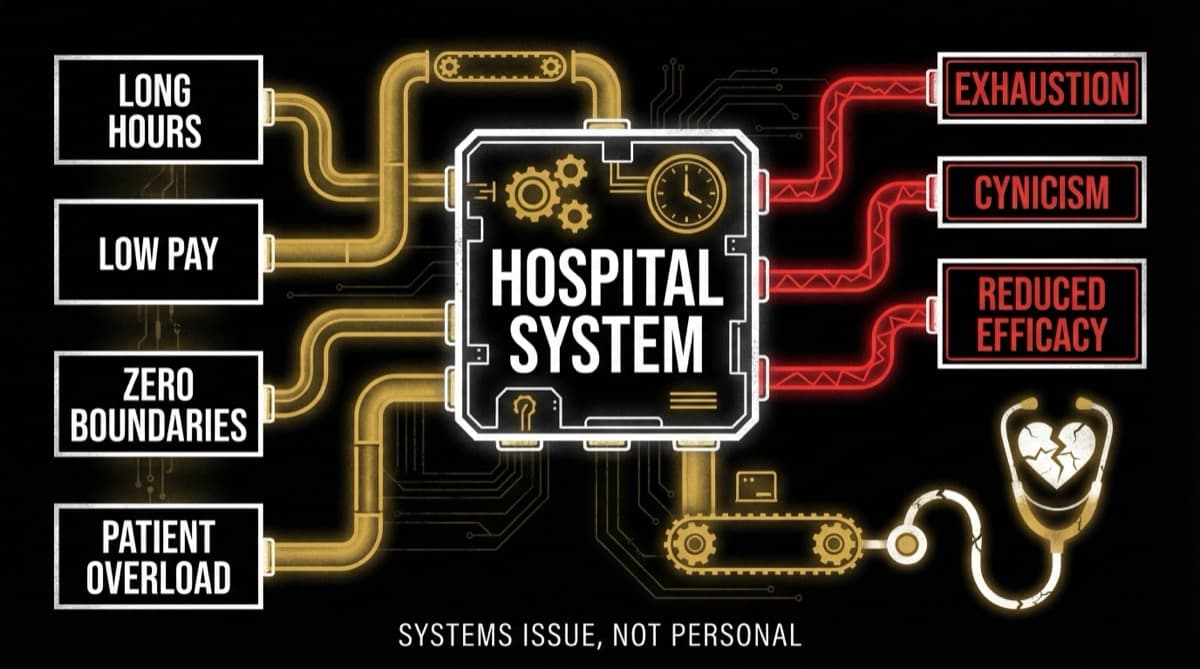
Female doctors work 12-15% more hours per week (60+ vs 54 hours), their patients have better health outcomes (lower readmission, better compliance), yet they earn 25-35% less. The system rewards billing speed, not care quality. 60% of female doctors report greater burnout than male colleagues, but the market doesn't pay for the outcomes they produce.
The Hours-to-Income Paradox
Female doctors: 56 total weekly hours, 32 billable hours. Male doctors: 47 total weekly hours, 35 billable hours. Female doctors work 19% more total hours but bill 9% fewer hours. That's 9 hours/week of unpaid labor.
Effective hourly rate: Female doctors Rs 286/hour. Male doctors Rs 372/hour. Gap: -23%.
Female doctors are paid 23% less per hour worked because they're doing more hours but billing fewer of them.
Q.How Do Care Quality vs Market Compensation Compare?
Q.How Does Patient Outcomes — Female vs Male Doctors: Work?
Patient satisfaction score: Female 4.6/5 vs Male 4.1/5 (+12%). Treatment compliance: Female 78% vs Male 65% (+20%). Hospital readmission rate: Female 8.2% vs Male 12.1% (32% lower). Medication adherence: Female 82% vs Male 71% (+15%). Complication rate (surgery): Female 4.1% vs Male 6.3% (35% lower). Emergency return visits: Female 5.2% vs Male 9.8% (47% lower).
What's producing these better outcomes? More thorough documentation (4 extra hours/week). More patient education (consults run 15-18 min vs 10-12 min). More proactive follow-ups (5 hours/week vs 2 hours). Better medication management.
The Market Compensation for Better Outcomes: Consultation fee Rs 500 (same regardless of duration). Treatment compliance (you can't bill for this) Rs 0. Lower readmission (hospital benefits, not you) Rs 0. Patient satisfaction (nice to have, unpaid) Rs 0. Fewer complications (actually reduces your billings) negative value.
Market structure: You earn the same Rs 500 whether you spend 10 minutes or 18 minutes. You earn zero for better outcomes. You actually lose money on avoided complications.
Q.What Is the 60% Burnout Epidemic?
Patient expectation exhaustion: 65% female report high vs 35% male. Work-life boundary blurring: 72% female vs 48% male. Perfectionism/self-blame for outcomes: 58% female vs 28% male. Imposter syndrome: 52% female vs 18% male.
Better outcomes come from unsustainable effort. That 4 extra hours of documentation? Not sustainable long-term. Female doctors achieve better outcomes by working harder, which burns them out, and they're paid the same as doctors who work less and achieve worse outcomes.
Need help with this?
Our team specializes in healthcare branding. Get personalized advice in a free 15-minute call.
Book a free 15-minute callQ.Why the System Rewards Billing Speed, Not Care Quality?
Private healthcare in India is transaction-based, not outcome-based: Fee-per-consultation model (same for 10-min and 20-min consultation). No outcome-based bonuses. No readmission penalties. No quality metrics tied to payment. Volume-based incentives.
This incentivizes speed over quality, intervention over prevention, complexity over simplicity, billing over caring.
Female doctors are trying to optimize for outcomes in a system optimized for transactions. They can't win.
Frequently Asked Questions
Q: But if female doctors produce better outcomes, shouldn't hospitals hire them?
A: Hospitals care about profit margins, not outcome quality. A male doctor who sees 40 patients/day at Rs 500 generates Rs 20,000. A female doctor who sees 25 at same rate generates Rs 12,500. Hospital profit: Male greater than Female, even though outcomes are better with female doctor.
Q: Isn't "emotional labor" just being nice? Why should it be paid extra?
A: Because it produces outcomes. A patient who understands their disease takes medication correctly. A patient who feels heard attends follow-ups. This isn't "being nice" — it's clinical labor that directly improves health outcomes.
The Structural Reality
Female doctors work longer, produce better outcomes, burn out more, and earn less. This isn't a coincidence — it's a market failure.
What needs to change: Payment models tied to outcomes (readmission rates, patient satisfaction, long-term health metrics). Time recognition (bill for documentation, education, follow-ups). Female-friendly incentives (reward care quality, not speed). Burnout accountability (hospital responsible for maintaining work hours).
Until then, the paradox remains: Female doctors work more, produce better health outcomes, and earn less. The system isn't broken — it's working exactly as designed.
futurise. builds premium healthcare brands in 48 hours. Learn more at futurise.studio