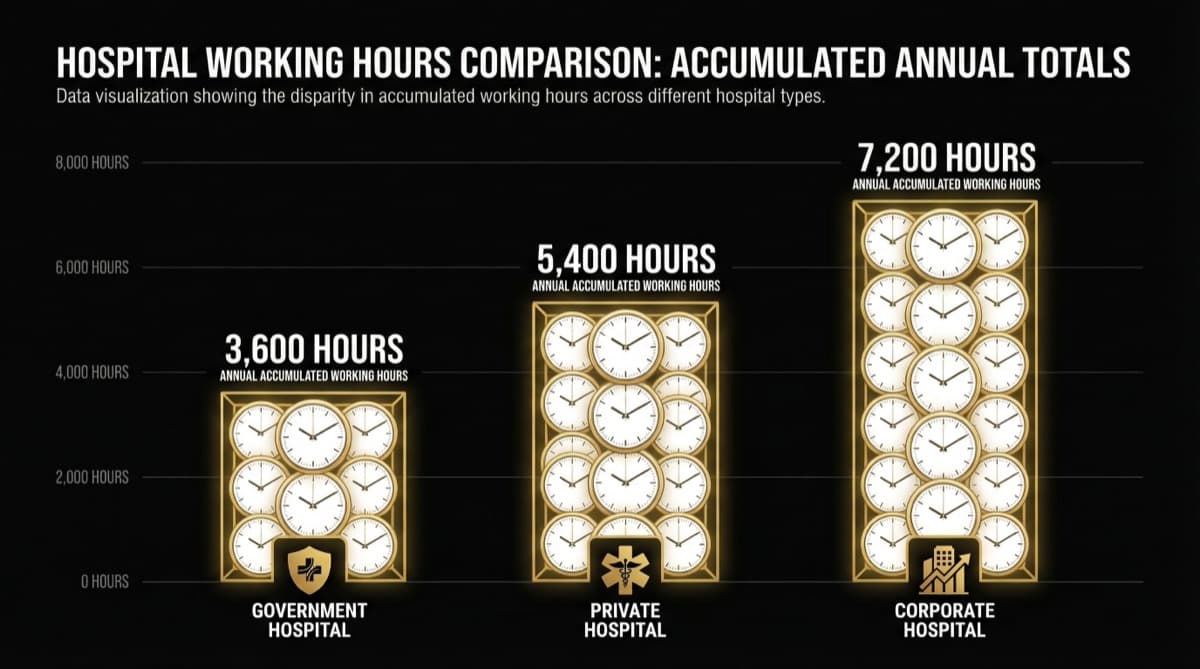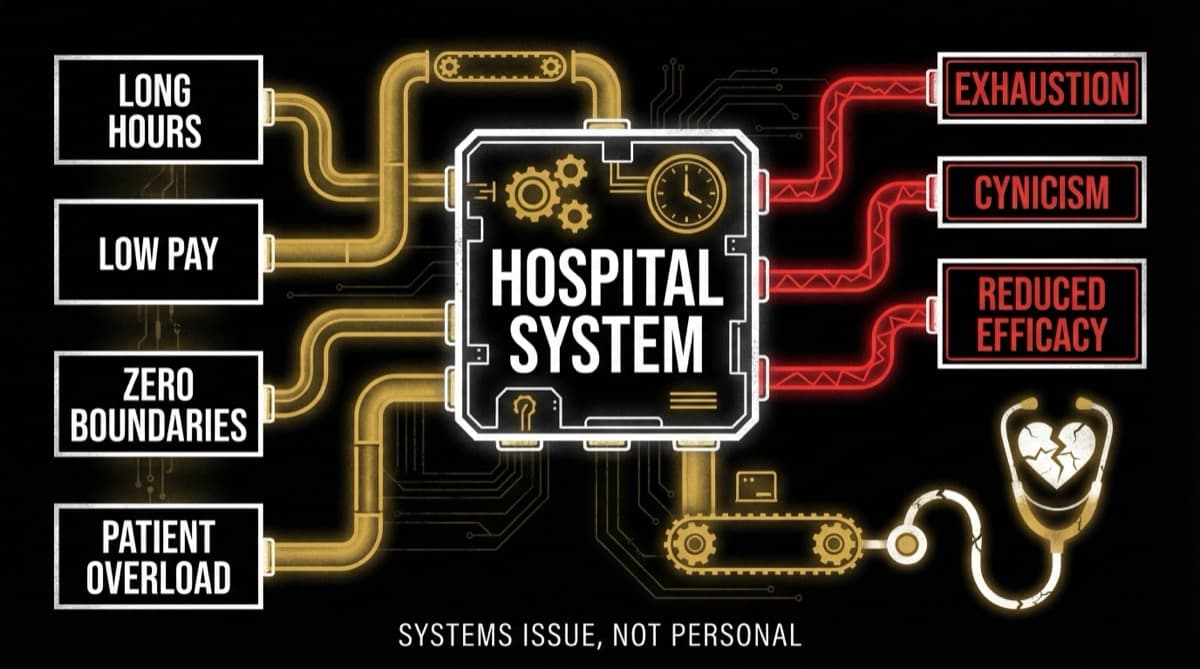
Doctor burnout in India is not a failure of individual resilience — it's an engineered outcome of a system that puts 50% of doctors through 60+ hour weeks, maintains a doctor-to-population ratio of 1:1,500 (and 1:25,000 for specialists in rural areas), and offers zero structural support for mental health. Over 80% of Indian doctors report being overwhelmed and stressed, 42% meet clinical burnout criteria, and 83% report mental or emotional fatigue. These aren't personal failures — they're the predictable result of a healthcare system that treats doctor capacity as infinite and doctor wellbeing as irrelevant.
What Do the Numbers Reveal About Doctor Burnout in India?
The data paints a stark picture. Doctors reporting burnout symptoms | 80%+ overwhelmed/stressed | IMA National Survey 2025 Doctors meeting clinical burnout criteria | 42% (Goa branch study) | IMA-Goa / Sangath 2024 Doctors reporting mental/emotional fatigue | 83% | Knya Vitals 2025 Report Doctors working 60+ hours/week | 50% | Knya Vitals / Medical Buyer 2025 Doctors working 80+ hours/week | 15% | Knya Vitals 2025 Report Young doctors (25-34) regretting personal sacrifices | 70% | Business Standard / National Doctor's Day Survey 2025 Female doctors experiencing mental exhaustion | 87% (vs 77% male) | IMA Survey 2025 Doctors feeling undervalued | 43% | Knya Vitals 2025 Doctors in Tier 2/3 cities reporting fatigue | 85% | Knya Vitals 2025 Doctors feeling pressure to violate ethical standards | 50% | Knya Vitals 2025
What Are the Five Structural Causes of Doctor Burnout in India?
Burnout stems from five system-level failures, not individual weakness. 1. The Ratio Problem: Too Few Doctors for Too Many Patients
India's doctor-to-population ratio is officially 1:834, but this national average hides a distribution disaster. For specialists in rural areas, the ratio can be 1:25,000. Even in urban government hospitals, a specialist sees 100-150 patients per day — a volume that makes meaningful clinical interaction mathematically impossible.
The structural cause: India spends 2.1% of GDP on healthcare versus the UK's 10%. Low spending means fewer hospitals, fewer beds, and fewer doctors per population unit. The doctors who exist absorb the entire overflow.
This is not about doctors working harder. It's about a system that structurally under-resources healthcare and asks doctors to compensate with their time and health.
- 1The Hours Problem: 60-100 Hour Weeks as Structural Norm
Half of India's doctors work more than 60 hours a week. 15% exceed 80 hours. Resident doctors in government hospitals average 100-120 hours per week, with continuous shifts extending beyond 36 hours — directly violating the NMC's own PGMER Guidelines (2023), which cap shifts at 12 hours and weekly hours at 48.
The structural cause: hospitals (both government and private) are designed around minimum staffing models. Rather than hiring adequate staff and paying overtime, the system relies on existing doctors working beyond sustainable limits. In government hospitals, posts remain vacant for years. In corporate hospitals, staffing is optimized for EBITDA, not for doctor wellbeing.
- 1The Violence Problem: Fear as a Daily Workplace Reality
46.3% of doctors cite fear of violence as their primary stressor. Doctor-patient violence is not an aberration in Indian healthcare — it's a structural feature of a system where patients wait 4-6 hours to see a doctor for 3 minutes, where hospital billing is opaque, and where doctors bear the blame for systemic failures.
The structural cause: when a patient dies after a 6-hour ER wait because there was one doctor for 200 patients, the family doesn't blame the government's healthcare budget. They blame the doctor standing in front of them. Doctors absorb system failure as personal blame — and sometimes as physical assault.
- 1The Financial Pressure Problem: Debt, Low Pay, and Delayed Returns
MBBS doctors start earning at Rs 40,000-90,000/month in private hospitals — after a minimum 5.5 years of medical college plus 1 year internship, often with educational debt of Rs 25-50 lakhs for private medical college graduates. PG completion pushes the "real earning" start date to age 27-30.
Meanwhile, MBA graduates from comparable backgrounds hit Rs 10-20 lakhs/year by age 24-26. This structural ROI gap creates financial stress that compounds the emotional and physical toll of clinical work.
- 1The Silence Problem: No Support Infrastructure
There is no systematic mental health support for doctors in India. No mandatory counseling access. No formal peer support programs. No structural acknowledgment that working 100-hour weeks in high-stakes environments causes psychological damage.
When a doctor experiencing burnout seeks help, they face stigma from colleagues, fear of being seen as "weak," and practical barriers — when are you supposed to see a therapist when you're working 80 hours a week?
Why Does "Resilience Training" Miss the Point on Doctor Burnout?
The most common institutional response to doctor burnout is "wellness programs" — meditation workshops, yoga sessions, resilience training. These treat burnout as an individual coping failure rather than a structural design problem.
The analogy: if a bridge collapses because it was designed for 10 tonnes but routinely carries 50 tonnes, you don't fix it by training the bridge to be more resilient. You fix the load or you fix the bridge.
Indian healthcare's "bridge" was designed for a doctor-to-patient ratio that doesn't exist in practice, working hours that violate its own regulations, and support infrastructure that was never built. No amount of individual resilience compensates for structural under-resourcing.
What Do Structural Solutions for Doctor Burnout Actually Look Like?
Real solutions address the system, not the individual:
Working hours enforcement: India already has regulations (NMC PGMER Guidelines cap shifts at 12 hours, weeks at 48 hours). Enforcement is the gap — not policy. Tie medical college accreditation to verified compliance with duty hour limits.
Staff-to-patient ratios: Mandate minimum doctor-to-patient ratios in government and accredited private hospitals, similar to nurse-to-patient ratios mandated in several countries. This makes the invisible cost of understaffing visible and budgetable.
Financial restructuring: Address the ROI problem directly — higher starting salaries, educational loan restructuring for government service, and closing the 10-15 year gap between educational investment and meaningful income.
Mental health infrastructure: Mandatory, confidential, free counseling access for all doctors — not as a "wellness benefit" but as a structural requirement, like PPE in an ICU.
Frequently Asked Questions
How common is burnout among Indian doctors? Surveys consistently show 42-80% of Indian doctors experience burnout symptoms. The wide range reflects different measurement tools, but even the conservative estimate (42%, from the IMA-Goa/Sangath study using validated clinical instruments) means nearly half of Indian doctors meet clinical burnout criteria.
Do government doctors burn out more than private hospital doctors? Both burn out, but from different structural causes. Government doctors face overwhelming patient volumes (100-150 patients/day for specialists) and resource shortages. Corporate hospital doctors face EBITDA-driven throughput pressure, compensation restructuring, and loss of clinical autonomy. The mechanisms differ; the outcome is the same.
Why is burnout worse for younger doctors? Doctors aged 25-34 work the longest hours and report the highest regret levels (70% regretting personal sacrifices). They're in the phase of maximum clinical workload with minimum compensation, autonomy, and institutional power. Burnout at this career stage has lifetime consequences — it shapes whether they stay in clinical medicine at all.
Is doctor burnout getting better or worse? Worse. The structural drivers are intensifying — PE-backed hospitals increase throughput pressure, medical seat expansion floods the market with graduates competing for limited positions, and healthcare spending remains at 2.1% of GDP despite a growing and aging population. Without structural intervention, the trajectory continues downward.
What should a burned-out doctor actually do? First, recognize it as a structural problem, not a personal failure. Second, assess whether your specific situation (hospital type, specialty, geography) has modifiable factors. Third, consider whether building patient loyalty outside the hospital system gives you more autonomy and control. And critically — if you're experiencing suicidal thoughts, reach out to Vandrevala Foundation Helpline (1860-2662-345) or iCall (9152987821). These are real structural resources, and using them is not weakness.
futurise. builds premium healthcare brands in 48 hours. Learn more at futurise.studio