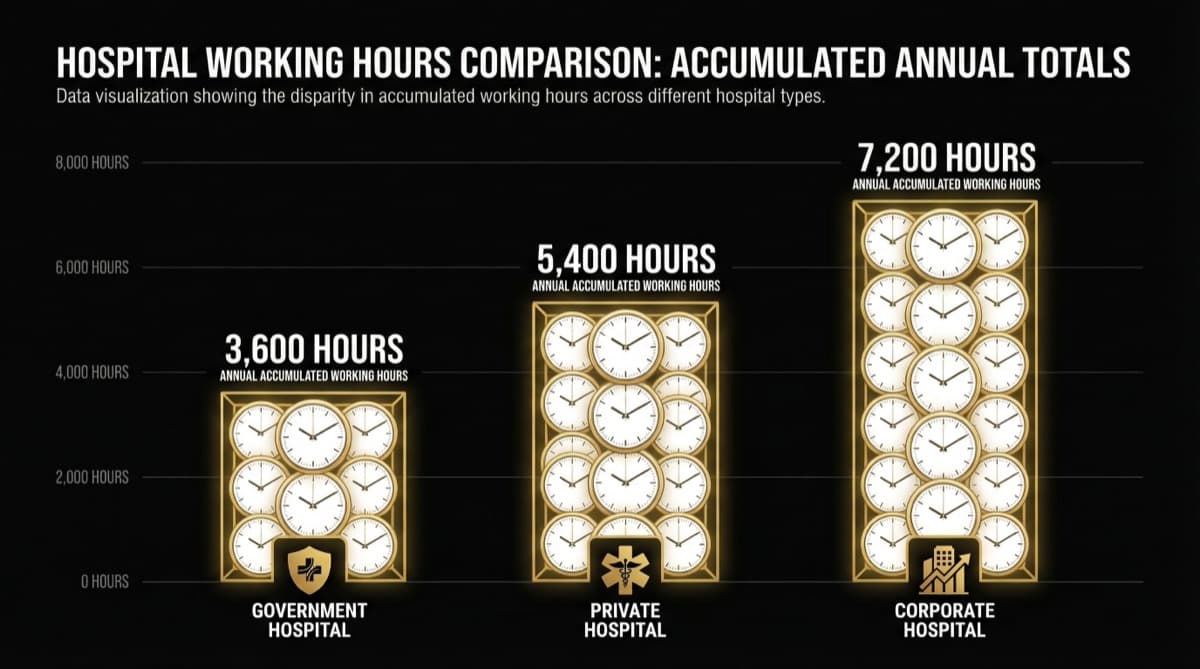
Indian doctors work an average of 60+ hours per week — but this national figure masks enormous variation by hospital type. Government hospital residents regularly clock 100-120 hours per week with 36-hour continuous shifts. Private hospital consultants work 50-70 hours per week with on-call obligations. Corporate (PE-backed) hospital doctors work 55-75 hours per week under throughput-optimized schedules. According to the Knya Vitals 2025 report, 50% of Indian doctors exceed 60 hours weekly and 15% exceed 80 hours — making Indian doctors among the most overworked in the world.
How Do Working Hours Compare Across Hospital Types?
The data shows enormous variation by setting. Government (Residents) | 100-120 hours | 36-hour continuous shifts + post-call duties | Continuous | Patient volume (100-150/day), understaffing Government (Consultants) | 48-60 hours | 8-12 hour shifts, 6 days/week | Variable by department | OPD volume, resource shortages Private (Independent/Small) | 50-70 hours | Self-scheduled but demand-driven | Self-managed | Revenue pressure, overhead costs Corporate (PE-backed) | 55-75 hours | Hospital-managed scheduling | Structured rotations | ARPOB targets, throughput KPIs Academic/Teaching | 60-80 hours | Clinical + teaching + research | Department-specific | Triple workload without triple pay
Why Are Government Hospital Working Hours So Extreme?
Government hospital doctors face the rawest form of overwork — pure patient volume with inadequate staffing.
Resident doctors in government hospitals represent the most extreme case. Despite NMC's PGMER Guidelines (2023) capping shifts at 12 hours and weekly hours at 48, RTI responses confirm that residents at institutions including AIIMS Bhubaneswar and AFMC Pune work 36-hour continuous shifts routinely. A resident doctor in a busy government hospital emergency department may see 80-120 patients in a single shift.
The structural cause is simple arithmetic: government hospitals serve 70% of India's population but have chronic specialist vacancies. The National Health Profile shows 88% specialist vacancies in rural community health centres. Urban government hospitals fare better but still operate with 30-40% position vacancies.
Consultant doctors in government hospitals have more regulated hours (48-60 per week) but face overwhelming OPD volumes. A government hospital specialist seeing 100-150 outpatients per day has approximately 3-4 minutes per consultation — barely enough for history-taking, let alone meaningful clinical interaction.
The trade-off: Government doctors work brutal hours but get job security, pension, regular increments, and the ability to do private practice (in some states). The compensation per hour is lower, but the long-term financial architecture is more stable.
How Do Working Hours Work in Private Hospitals and Small Chains?
Doctors in independent private hospitals and small chains face a different working hours dynamic — their hours are directly tied to revenue generation.
The revenue-share model means more patients = more income. A surgeon who could work 50 hours/week often works 65-70 because each additional surgery adds directly to their income. The incentive structure rewards overwork.
OPD and surgical scheduling is largely self-determined, giving these doctors more autonomy than their government or corporate counterparts. However, this autonomy comes with the pressure of generating enough revenue to cover clinic overheads, EMIs, and personal income needs.
On-call burden is self-managed, which means it's often 24/7 — especially for surgeons in smaller setups where there's no backup consultant. A single surgeon running an independent practice may be effectively on-call 365 days a year.
How Are Working Hours Structured in Corporate PE-Backed Hospitals?
Corporate hospital working hours represent the most structurally designed workload in Indian medicine.
Hospital-managed scheduling replaces self-scheduling. OPD slots are fixed (typically 10-15 minute consultations). Surgical lists are coordinated for bed turnover optimization. Your schedule serves the hospital's ARPOB targets, not your clinical preferences.
The throughput pressure is distinct from government volume. In government hospitals, volume is driven by patient demand overwhelming capacity. In corporate hospitals, volume is driven by management targets designed to maximize bed utilization and revenue per doctor.
Working hours are typically 55-75 per week, which is marginally better than government residency but worse than what the structured setting suggests. The difference is that corporate hours are packed with higher-intensity work — every slot is filled, every minute is scheduled, and "downtime" between patients is minimized by design.
The key difference from other settings: corporate hospital doctors lose control over their time. In government and private settings, long hours may be exhausting but the doctor retains some scheduling autonomy. In corporate settings, the hospital owns your schedule as an operational input.
Why Do Doctor Working Hours Remain Unregulated in Practice?
India has working hour regulations for doctors. The problem is enforcement.
NMC PGMER Guidelines 2023 cap resident duty hours at 48 per week and 12 hours per continuous shift. A Supreme Court petition (United Doctors Front vs Union of India) is actively seeking enforcement of these limits.
Reality versus regulation: RTI data shows systematic violations at premier institutions. The gap between policy and practice exists because medical college accreditation doesn't effectively tie compliance to working hour limits, and hospitals face no financial penalty for overworking residents.
Why enforcement fails:
- Hospitals are understaffed by design — enforcing hour limits would require hiring more doctors, which costs more
- The culture frames overwork as "dedication" and compliance with hour limits as "laziness"
- Residents who complain risk academic consequences — their academic supervisors control their training assessments
- There's no independent monitoring body specifically tracking duty hour compliance
What Is the Health Cost of These Excessive Working Hours?
Working hours aren't just a convenience issue — they have direct clinical consequences:
- First-year residents make 36% more serious medical errors when working frequent shifts of 24+ hours compared to shorter shifts
- 42% of Indian doctors meet clinical burnout criteria (IMA-Goa/Sangath 2024)
- 1 in 3 postgraduate students have experienced suicidal ideation (NMC survey 2024)
- Doctors in Tier 2/3 cities working longest hours report 85% fatigue rates — 11% higher than Tier 1 peers
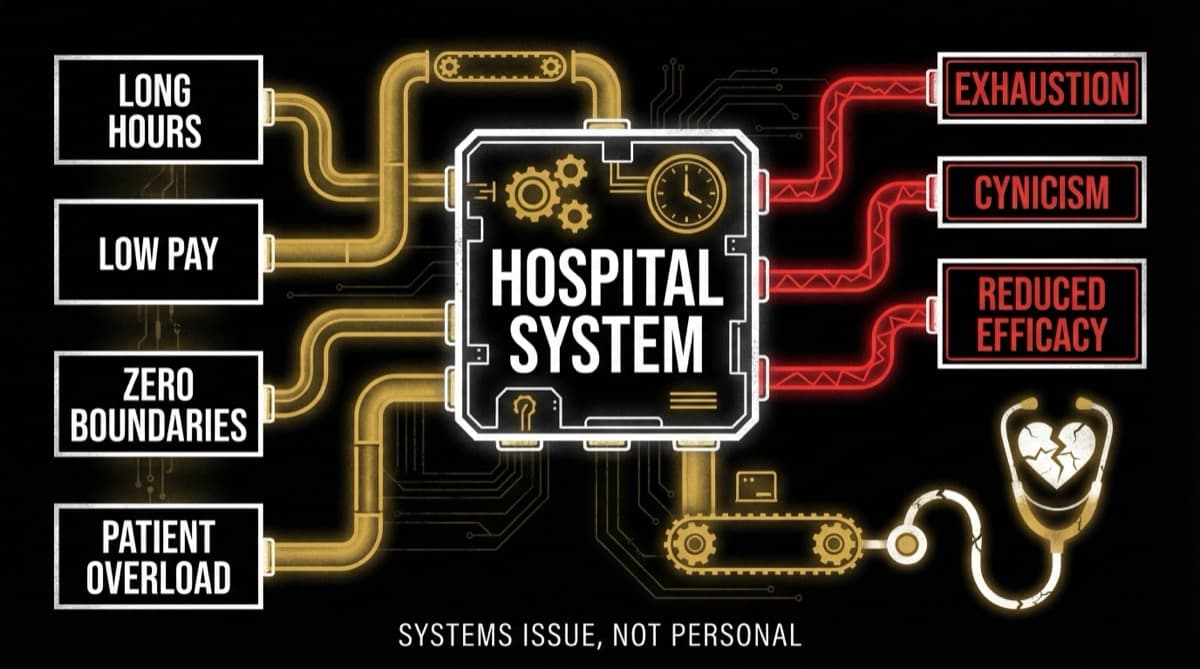
The system extracts maximum output from doctors while investing minimum resources in their sustainability. This is a design choice, not an inevitability.
Frequently Asked Questions
What are the legal working hours for doctors in India? NMC PGMER Guidelines (2023) cap resident working hours at 48 per week with a maximum 12-hour continuous shift. For employed consultants, the Shops and Establishments Act in most states limits working hours to 48 per week. In practice, both are routinely violated without consequence.
Do corporate hospital doctors work less than government doctors? Not necessarily less in total hours, but differently. Corporate doctors typically work 55-75 hours/week in highly structured, throughput-optimized schedules. Government residents work 100-120 hours in chaotic, volume-driven conditions. The corporate environment is more controlled but less autonomous.
Why don't doctors unionize to demand better hours? Several factors: the culture frames overwork as professional dedication, residents fear academic retaliation, the Indian Medical Association (IMA) functions more as a professional body than a labor union, and the Essential Services Maintenance Act (ESMA) restricts healthcare worker strikes in many states.
Which hospital type offers the best work-life balance? Academic consensus suggests government consultant positions (post-residency) offer the most predictable hours relative to compensation and job security. Private practice offers scheduling autonomy but unlimited on-call demands. Corporate hospitals offer structured hours but limited autonomy. There is no option in Indian medicine that resembles a 40-hour work week.
How do Indian doctor working hours compare internationally? The EU Working Time Directive caps doctor hours at 48 per week. The US ACGME caps residents at 80 hours/week (already considered excessive internationally). Indian residents routinely exceed even the US limit. India is the only major healthcare system where 100+ hour weeks for trainees are structural norms rather than exceptions.
futurise. builds premium healthcare brands in 48 hours. Learn more at futurise.studio