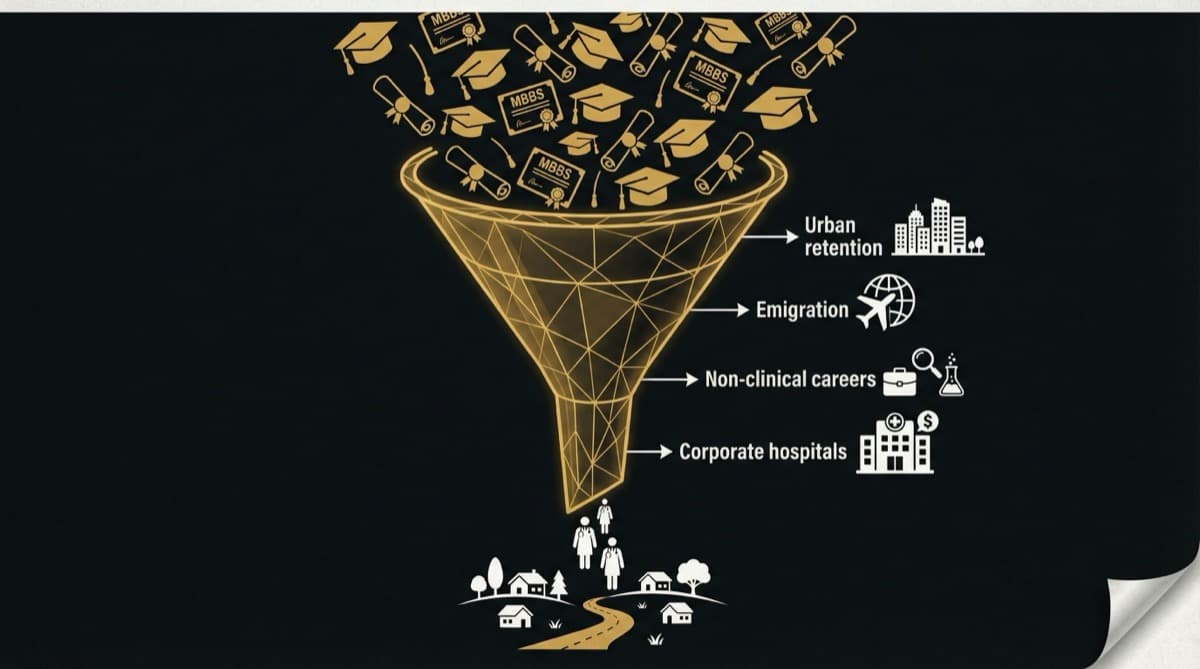
India expanded MBBS seats from 49,000 to 1,18,000 in a decade — a 140% increase — yet rural specialist vacancies went from 44% to 88% in the same period. The doctor shortage isn't a production problem — it's a distribution problem. More graduates don't go where doctors are needed because the structural incentives (salary, infrastructure, career growth, children's education, safety) all point toward cities. You can double MBBS seats again and rural India will still have no cardiologist, no oncologist, and no neurosurgeon — because education policy can't fix market incentive problems. Production does not equal distribution does not equal retention.
What Numbers Expose the Paradox of More Seats but Worse Shortages?
The data reveals a striking contradiction. MBBS seats | 49,000 | 1,18,000 | +140% Medical colleges | 381 | 780+ | +105% Annual MBBS graduates | ~45,000 | ~1,10,000 | +144% National doctor-to-population ratio | 1:1,596 | 1:834 | Improved Rural specialist vacancies (CHC) | 44% (2010 estimate) | 88% | Worsened Doctors in urban areas | ~70% | ~70% | Unchanged Population in rural areas | ~69% | ~65% | Slightly decreased
The paradox in one line: India produced 140% more doctors but rural specialist vacancies doubled. How is this possible?
Because doctors produced in urban medical colleges stay in urban areas. The training pipeline adds to urban supply (where there's already relative adequacy) while doing nothing for rural supply (where there's severe shortage).
Why Don't Doctors Go to Rural Areas — What Are the Five Structural Barriers?
Five interconnected barriers keep doctors in cities. 1. The Salary Gap
A specialist in a metro corporate hospital earns Rs 30-80 LPA. The same specialist in a rural community health centre earns Rs 8-15 LPA under government pay scales. Even with rural allowances, the income gap is 3-5x.
For a doctor carrying Rs 50 lakhs in educational debt (private college graduate), the rural salary doesn't cover loan EMIs plus basic living expenses. The financial math literally prevents rural practice for debt-burdened graduates.
- 1No Career Growth Infrastructure
Rural postings are career dead-ends in the current system. There's no:
- Continuing medical education access
- Specialty training opportunities
- Research infrastructure
- Peer consultation network
- Professional development pathway
A young specialist posted to a rural CHC for 3 years falls behind their urban peers in clinical skills, professional network, and career progression. The opportunity cost isn't just salary — it's career trajectory.
- 1Quality of Life (Schools, Safety, Social Life)
Doctors are also parents, partners, and individuals. Rural postings mean:
- Limited education options for children (the #1 cited reason for refusing rural postings)
- Spousal career disruption
- Social isolation
- Limited access to consumer goods, entertainment, and services
- In many areas, safety concerns (especially for female doctors — 72% report feeling unsafe in Tier 2/3 cities)
- 1Solo Practice Without Backup
Rural specialists often practice alone — no other specialist in the same field within accessible distance. This means:
- No peer consultation for complex cases
- No surgical backup for complications
- Personal liability for every decision without institutional support
- 24/7 availability with no handover option
The clinical isolation is both professionally risky and personally exhausting.
- 1The Bond System Doesn't Work
Many states implement service bonds requiring government-college graduates to serve in rural areas for 1-3 years. In practice:
- Many doctors pay the bond penalty (Rs 5-25 lakhs) rather than serve
- Those who do serve count the days until release
- Forced rural postings create resentful, temporary doctors — not committed rural practitioners
- Bond enforcement is inconsistent across states
Bonds address the symptom (doctors won't go rural) without addressing the cause (there's no structural reason to stay).
What Would Actually Work to Get Doctors to Rural India?
Five evidence-based interventions could shift the distribution. 1. Financial Incentives That Match Market Reality
Rural specialist salaries need to be 2-3x urban equivalents, not 0.3x. This sounds expensive but consider: the government already spends Rs 30-50 lakhs training each MBBS doctor. Spending Rs 20-30 lakhs more per year on rural retention would ensure the training investment actually reaches the population it's intended to serve.
- 1Training Rural Doctors in Rural Settings
Doctors trained in urban tertiary care hospitals are clinically prepared for urban tertiary care. Training programs based in rural district hospitals would produce doctors whose clinical skills, expectations, and professional networks are already adapted to rural practice.
- 1Career Progression Tied to Rural Service
Instead of rural posting as a dead-end, create a pathway where rural service provides preferential access to: PG admission, government appointments, academic positions, and leadership roles. Make rural service a career accelerator, not a career penalty.
- 1Telemedicine and Referral Networks
Technology can partially bridge the clinical isolation gap. A rural surgeon connected to urban super-specialists via telemedicine for real-time consultation is less isolated and more clinically confident. Structured referral pathways ensure complex cases get transferred efficiently.
- 1Community Investment, Not Just Doctor Deployment
If a rural posting includes quality schools for children, spousal employment support, safe housing, and reasonable social infrastructure — the "quality of life" barrier reduces significantly. The cost of these investments is a fraction of the cost of perpetual rural vacancies.
Frequently Asked Questions
Does India have enough doctors? In absolute numbers, India is approaching WHO's recommendation of 1 doctor per 1,000 population. But this national average hides massive distribution inequality: urban areas have roughly 1:400 ratios while rural specialist ratios can be 1:25,000. India has enough doctors — they're just all in the same places.
Will more medical colleges solve the doctor shortage? No — unless the colleges are specifically designed for and located in underserved areas, with training models that prepare graduates for rural practice and incentive structures that encourage rural retention. Simply adding more colleges in urban areas produces more urban doctors.
Why can't the government just mandate rural service? It can, and some states do (through service bonds). But mandatory service produces short-term, reluctant practitioners. The evidence from states with bond systems shows high buyout rates, poor retention, and limited community impact. Sustainable rural healthcare requires doctors who choose to be there — which requires making the choice rational.
How many doctors does rural India actually need? Based on Indian Public Health Standards (IPHS), community health centres should have at least 4 specialists (medicine, surgery, OB-GYN, pediatrics). With approximately 5,600 CHCs and an 88% specialist vacancy rate, India needs roughly 20,000 additional rural specialists just to meet minimum standards. Current annual specialist output (~35,000) could fill this — if the incentives directed even a fraction to rural areas.
What can individual doctors do about this? If you choose rural practice, you're filling a genuine need with limited competition — which can translate to both clinical impact and financial opportunity (especially in underserved specialties). The structural barriers are real, but so are the opportunities for doctors who find ways to address them.
futurise. builds premium healthcare brands in 48 hours. Learn more at futurise.studio