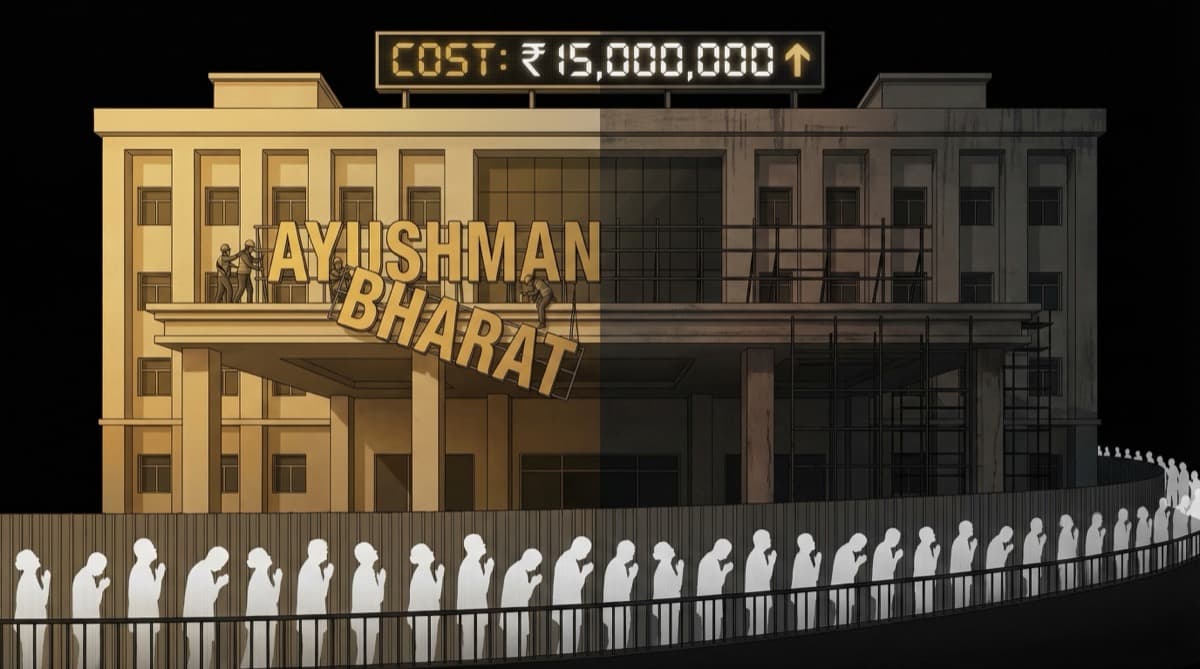
Ayushman Bharat (PM-JAY) reimburses hospitals at rates that are 30-60% below actual treatment costs for most procedures. A caesarean section that costs a private hospital Rs 25,000-40,000 to perform is reimbursed at Rs 9,000-18,000 under PMJAY. A knee replacement costing Rs 80,000-1.2 lakhs gets Rs 50,000-80,000. The result: hospital empanelment under PMJAY has dropped from 316 new hospitals per month in 2024 to just 111 per month in 2025, and 650 private hospitals in Haryana alone suspended all PMJAY services over Rs 490 crore in unpaid dues.
How Large Is the Rate Gap Between PMJAY Rates and Actual Costs?
The gap is significant across all major procedures. Normal Delivery | Rs 5,000-9,000 | Rs 15,000-25,000 | 40-65% below cost Caesarean Section | Rs 9,000-18,000 | Rs 25,000-45,000 | 50-65% below cost Appendectomy (Laparoscopic) | Rs 12,000-20,000 | Rs 30,000-50,000 | 50-60% below cost Cataract Surgery (Phaco + IOL) | Rs 10,000-15,000 | Rs 20,000-35,000 | 50-60% below cost Knee Replacement (Unilateral) | Rs 50,000-80,000 | Rs 80,000-1.5 lakhs | 30-50% below cost Coronary Angioplasty (Single Stent) | Rs 40,000-60,000 | Rs 80,000-1.5 lakhs | 40-55% below cost Dialysis (per session) | Rs 1,500-2,000 | Rs 2,500-4,000 | 40-50% below cost Hysterectomy | Rs 15,000-25,000 | Rs 40,000-70,000 | 55-65% below cost
Note: PMJAY rates are bundled package rates covering surgeon fees, anesthesia, room charges, consumables, and follow-up. "Actual cost" includes all these components at private hospital market rates. Government hospital costs are lower due to subsidized infrastructure, but still often exceed PMJAY rates.
Why Does the Rate Gap Between PMJAY and Actual Costs Exist?
The Rate-Setting Problem
PMJAY package rates were originally set in 2018 based on a combination of insurance claims data, expert consultations, and government hospital cost estimates. The methodology was not based on comprehensive, bottom-up hospital costing studies.
Since 2018, costs have risen significantly — medical inflation in India runs at 10-15% annually (higher than general inflation). While PMJAY revised its Health Benefit Package (HBP) with increased procedures (now 1,961) and raised rates for 350 packages, the revisions haven't kept pace with cost escalation.
What Was the Structural Design Choice Behind PMJAY's Low Rates?
PMJAY was designed as a pro-poor insurance scheme covering Rs 5 lakh per family per year for secondary and tertiary hospitalization. With a beneficiary base of over 55 crore people and a finite government budget, the scheme's financial architecture requires low per-procedure costs to remain sustainable.
This creates a fundamental tension: the government wants maximum coverage at minimum cost, while hospitals need reimbursement rates that cover actual expenses. Both are structurally rational positions — but the gap between them falls on hospitals, doctors, and ultimately patients.
How Does the Payment Delay Compounding Effect Worsen the Problem?
Low rates are compounded by payment delays. In Haryana, 650 private hospitals suspended PMJAY services because Rs 490 crore in reimbursements remained unpaid. Payment delays of 90-180 days are reported across states, turning an already below-cost reimbursement into a below-cost-with-delayed-payment reality.
For a hospital operating on working capital, a 120-day payment delay on a Rs 50,000 procedure effectively reduces the reimbursement by another Rs 2,000-3,000 in interest costs.
What Do Hospitals Do When PMJAY Rates Don't Cover Costs?
When reimbursement doesn't cover expenses, hospitals have four structural responses — none of them good for patients or doctors:
- 1Cost-Cutting on Treatment
- Using cheaper consumables and implants
- Reducing nursing staff ratios for PMJAY patients
- Shortening length of stay below clinical optimum
- Limiting diagnostic investigations to minimum required
- 1Patient Selection
- Accepting only "profitable" PMJAY procedures (those where the gap is smallest)
- Rejecting complex cases where costs are likely to exceed package rates
- Preferring patients whose conditions fit neatly within package definitions
- 1Cross-Subsidization
- Charging self-pay and privately insured patients more to subsidize PMJAY losses
- This effectively makes middle-class patients pay for the below-cost government scheme — a hidden redistribution mechanism
- 1De-Empanelment
- Simply leaving the scheme. Hospital empanelment dropped from 316 per month (2024) to 111 per month (2025)
- 609 private hospitals have voluntarily opted out since 2018
- 1,114 hospitals were de-empanelled for fraudulent activities (the flip side — some hospitals game the system to survive financially)
What Is the Doctor's Experience Working Under PMJAY?
For doctors working in PMJAY-empanelled hospitals, the impact is direct:
Surgeon fees are compressed. When the total package for a procedure is Rs 15,000 and the hospital needs to cover room, nursing, OT charges, and consumables, the surgeon's share can drop to Rs 3,000-5,000 — regardless of complexity.
Clinical decisions are constrained. You know the patient would benefit from a specific implant or additional investigation, but the package rate doesn't cover it. You choose between optimal care and financial viability.
Documentation burden increases. PMJAY has its own claim submission system, documentation requirements, and audit processes. Time spent on PMJAY paperwork is time not spent on patient care.
Volume pressure intensifies. To maintain revenue with below-cost reimbursement, hospitals push for higher patient volume. More PMJAY patients at Rs 15,000 each means more procedures at lower quality margins.
What Are the Key Numbers That Frame the PMJAY Debate?
The scale of the scheme is enormous. PMJAY beneficiary base | 55+ crore people | NHA 2024 Total procedures covered | 1,961 packages | Revised HBP 2024 Coverage per family per year | Rs 5 lakhs | PMJAY guidelines Hospital empanelment rate (2024) | 316/month | Medical Buyer 2025 Hospital empanelment rate (2025) | 111/month (65% drop) | Medical Buyer 2025 Hospitals voluntarily de-empanelled since 2018 | 609 | Government data / Outlook Money Hospitals de-empanelled for fraud | 1,114 | Government data / Outlook Money Hospitals suspended | 549 | Government data Haryana hospital suspension | 650 hospitals, Rs 490 crore unpaid | Health Policy Watch 2025
Frequently Asked Questions
Does Ayushman Bharat pay hospitals enough? For most procedures, no. PMJAY reimbursement rates are 30-60% below actual private hospital costs. The scheme was designed for maximum coverage on a limited budget, which structurally requires below-market rates. Government hospitals can absorb this because their infrastructure is already subsidized; private hospitals cannot.
Why don't hospitals just refuse PMJAY patients? Many are starting to — empanelment rates dropped 65% in one year. Hospitals that remain do so for several reasons: CSR obligations, government pressure, the hope of rate revisions, and the patient volume that PMJAY provides (which keeps beds occupied even at a loss). Some also cross-subsidize from private patients.
Are PMJAY rates being revised? Yes — the NHA revised the Health Benefit Package in 2024, increasing rates for 350 procedures and adding new packages. However, the revisions haven't matched cost escalation. Medical inflation of 10-15% annually means rate revisions need to be annual and substantial to maintain parity.
How do PMJAY rates compare to private insurance rates? PMJAY rates are generally 30-50% lower than private insurance package rates for equivalent procedures. Private insurance rates are themselves often below hospital list prices but closer to actual costs. CGHS (Central Government Health Scheme) rates are typically the highest, followed by private insurance, then PMJAY.
What happens to patients when hospitals leave PMJAY? They're redirected to remaining empanelled hospitals — usually government facilities that are already overcrowded. In Haryana, when 650 hospitals suspended services, government hospitals reported surge patient loads with longer wait times. The patient ultimately bears the cost of the rate gap.
futurise. builds premium healthcare brands in 48 hours. Learn more at futurise.studio