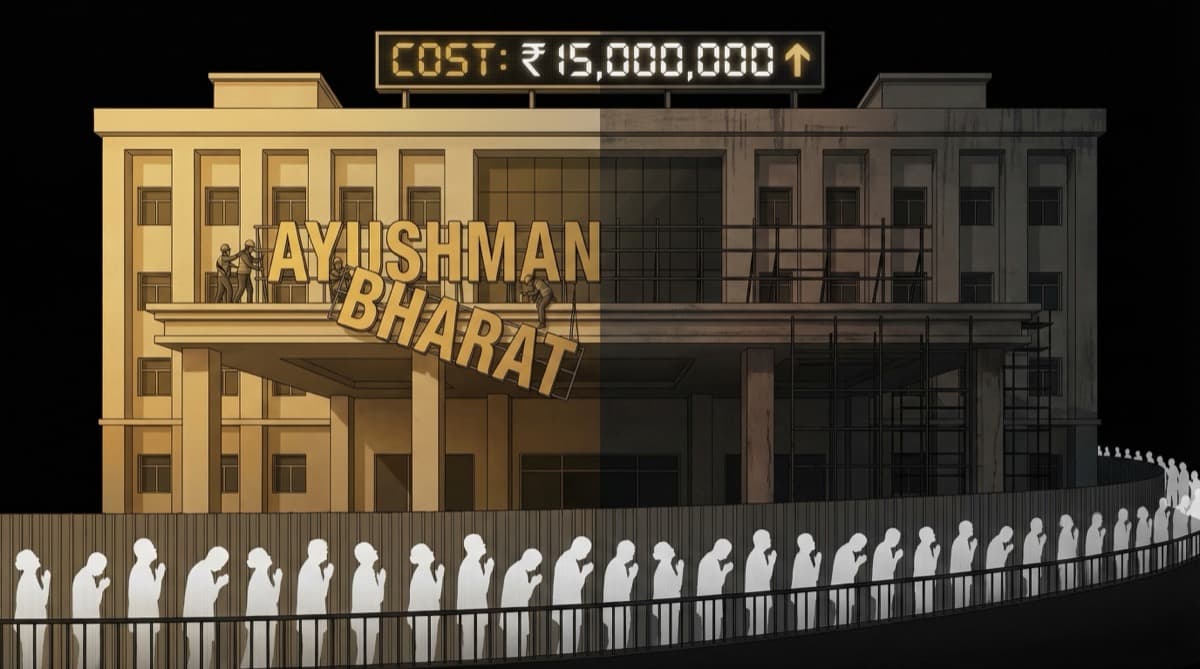
Hospital empanelment under Ayushman Bharat (PM-JAY) has dropped 65% — from 316 new hospitals per month in 2024 to just 111 per month in 2025. Over 609 private hospitals have voluntarily de-empanelled since the scheme launched in 2018. In Haryana, 650 hospitals suspended all PMJAY services simultaneously over Rs 490 crore in unpaid dues. The reason is structural: PMJAY reimburses 30-60% below actual treatment costs, payments are delayed 90-180 days, and the administrative burden makes participation financially unsustainable for most private hospitals.
How Large Is the Scale of Hospital Withdrawal From Ayushman Bharat?
The numbers reveal a structural trend. Hospitals voluntarily de-empanelled (since 2018) | 609 | Government of India data Hospitals de-empanelled for fraud | 1,114 | Government of India data Hospitals suspended | 549 | Government of India data Empanelment rate (2024) | 316 hospitals/month | Medical Buyer 2025 Empanelment rate (2025) | 111 hospitals/month | Medical Buyer 2025 Drop in empanelment rate | 65% decline | Medical Buyer 2025 Hospitals that suspended services in Haryana | 650 | Health Policy Watch 2025 Unpaid dues in Haryana alone | Rs 490 crore | Health Policy Watch 2025
This isn't a temporary disruption — it's a structural trend. The hospitals leaving are predominantly private facilities in the mid-size and large categories. Small nursing homes and government hospitals remain, but they lack the capacity and specialization to absorb the patient load.
What Are the Three Structural Reasons Hospitals Leave Ayushman Bharat?
Hospitals leave for three interconnected financial reasons. 1. Below-Cost Reimbursement
PMJAY package rates were set in 2018 and partially revised in 2024, but they remain 30-60% below actual private hospital costs for most procedures. Medical inflation in India runs at 10-15% annually — significantly higher than the rate revisions.
The financial math for a typical hospital:
- Accept 200 PMJAY patients/month
- Average procedure package: Rs 25,000
- Actual cost per procedure: Rs 45,000
- Monthly loss per PMJAY patient: Rs 20,000
- Total monthly loss on PMJAY: Rs 40 lakhs
- Annual loss: Rs 4.8 crore
No private business can sustain annual losses of Rs 4-5 crore on a single program, regardless of the social mission. Hospitals initially cross-subsidized from private patients, but as PMJAY volumes grew, the losses became unabsorbable.
- 1Payment Delays (90-180 Days)
Even the below-cost rates aren't paid on time. Payment delays of 90-180 days are reported across multiple states. For a hospital operating on working capital (often at 12-15% annual interest), a 120-day payment delay on a Rs 25,000 claim adds Rs 1,000-1,250 in financing cost.
The compounding effect: Below-cost rate + payment delay + interest cost = effective reimbursement that may be 40-70% below actual cost.
In Haryana, the accumulation of Rs 490 crore in unpaid dues triggered 650 hospitals to suspend services simultaneously. When government hospitals suddenly had to absorb the patient overflow, wait times increased and care quality dropped — exactly the outcome PMJAY was designed to prevent.
- 1Administrative Burden
PMJAY participation requires dedicated administrative staff for claim processing, pre-authorization management, documentation compliance, and audit responses. The cost of maintaining this infrastructure is not covered by PMJAY rates.
A mid-size hospital may need 2-3 full-time staff (Rs 4-6 lakhs/month) specifically for PMJAY administration. This is an overhead that doesn't exist for private-pay or commercially insured patients.
Additionally, the fraud monitoring system means hospitals face de-empanelment risk for documentation errors that may not be intentional — 1,114 hospitals were de-empanelled for fraud, but the line between fraud and documentation failure is often unclear.
What Happens to Patients When Hospitals Leave PMJAY?
The consequences cascade through the system. Immediate Impact: Patient Displacement
When 650 hospitals in a single state stop accepting PMJAY patients, those patients don't disappear. They go to:
- Government hospitals — already operating at or above capacity, with specialist vacancy rates of 40-80%
- Remaining private hospitals — which now face even higher PMJAY patient volumes, worsening their own financial sustainability
- Out-of-pocket payment — patients who can't access empanelled hospitals end up paying themselves, which defeats the scheme's purpose
Medium-Term Impact: Geographic Access Gaps
Private hospitals dropping PMJAY disproportionately affects Tier 2 and Tier 3 cities where government hospital infrastructure is weakest. In these areas, the private hospital was often the only facility offering specialized procedures. When it de-empanels, patients face 100-200 km travel for care that was previously available locally.
Long-Term Impact: Two-Tier Healthcare Consolidation
The structural trend creates an increasingly visible two-tier system:
- Tier 1: Private hospitals serving commercially insured and self-pay patients at market rates
- Tier 2: Government hospitals and remaining empanelled facilities serving PMJAY patients at constrained rates with constrained resources
Doctors increasingly choose Tier 1 facilities (better pay, better resources, less administrative burden), further depleting clinical talent in the PMJAY ecosystem.
What Does the Madhya Pradesh Situation Signal About PMJAY's Future?
In March 2026, Madhya Pradesh ordered all empanelled private hospitals in major cities to obtain Final-Level NABH certification by March 31 or lose PMJAY empanelment from April 1. NABH certification costs Rs 5-15 lakhs and takes 6-12 months.
This creates an additional barrier: hospitals already losing money on PMJAY must now invest in an expensive accreditation process to continue losing money. Many will choose to leave.
This pattern — increasing compliance requirements without increasing reimbursement — accelerates the de-empanelment trend.
What Would Fix the PMJAY Hospital Withdrawal Problem?
Four structural changes are needed. Rate rationalization: PMJAY rates need to be revised annually based on actual hospital costing data, not ad-hoc expert consultations. The NHA's own studies acknowledge that evidence-based rate-setting has been lacking.
Payment guarantee: Mandate 30-day payment cycles with interest penalties for delays. State governments that can't pay on time shouldn't be allowed to enroll new beneficiaries until dues are cleared.
Administrative simplification: Reduce the documentation and audit burden. Pre-authorization for standard procedures should be automatic, not case-by-case.
Hybrid models: Allow hospitals to charge a regulated co-payment above PMJAY rates for patients who can afford it, reducing the full gap between scheme rates and actual costs.
Frequently Asked Questions
Why are hospitals leaving Ayushman Bharat? Three structural reasons: (1) reimbursement rates 30-60% below actual costs, (2) payment delays of 90-180 days, and (3) administrative burden of compliance and documentation. The combination makes PMJAY participation financially unsustainable for most private hospitals.
Can the government force hospitals to accept PMJAY? Currently, no — PMJAY empanelment is voluntary for private hospitals. Some states have explored mandatory empanelment for hospitals receiving certain government benefits, but forcing private institutions to accept below-cost patients creates legal and practical challenges.
Will PMJAY rates increase? They have increased partially — the 2024 HBP revision raised rates for 350 procedures. But medical inflation at 10-15% annually means rates need substantial annual revision to keep pace. The political and fiscal constraints on PMJAY's budget limit how quickly rates can rise.
What should patients do if their hospital leaves PMJAY? Check the PMJAY hospital finder (hospitals.pmjay.gov.in) for alternative empanelled facilities. Consider government hospitals for the same procedures. If no empanelled hospital is accessible, file a grievance with the State Health Agency — patient grievances create pressure for the government to address access gaps.
Are government hospitals a good alternative? Government hospitals don't face the reimbursement gap (their infrastructure is government-funded), so they continue providing PMJAY services. However, they operate with specialist vacancy rates of 40-80% in rural areas and significant overcrowding in urban areas. The quality and access trade-off is real.
futurise. builds premium healthcare brands in 48 hours. Learn more at futurise.studio