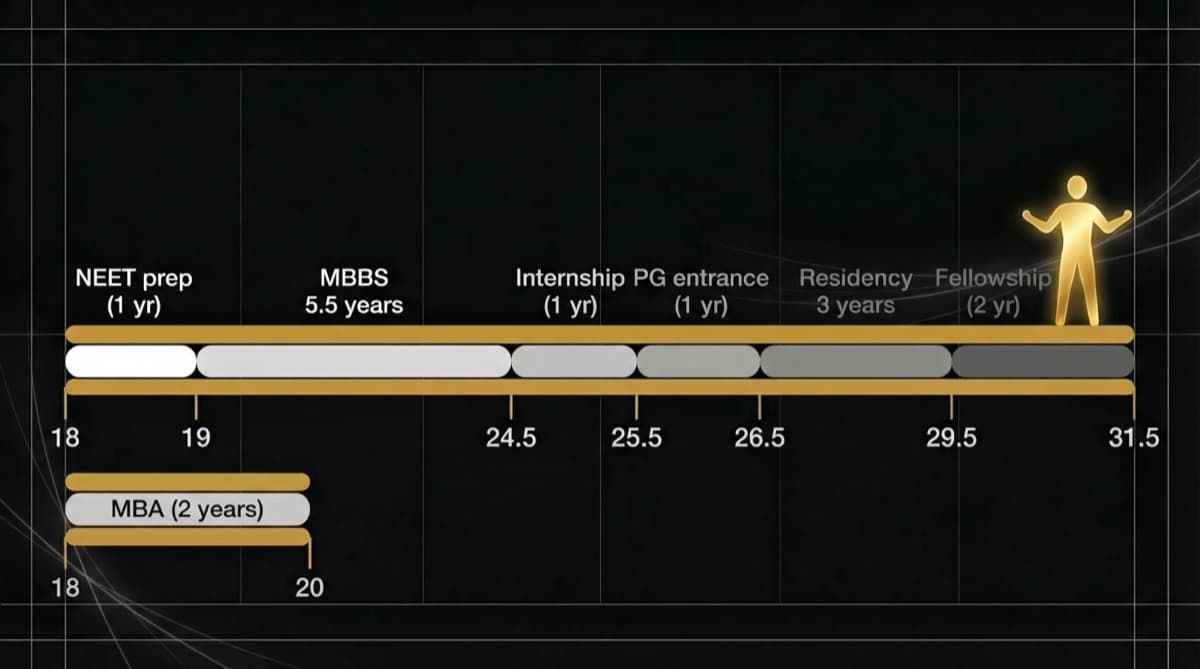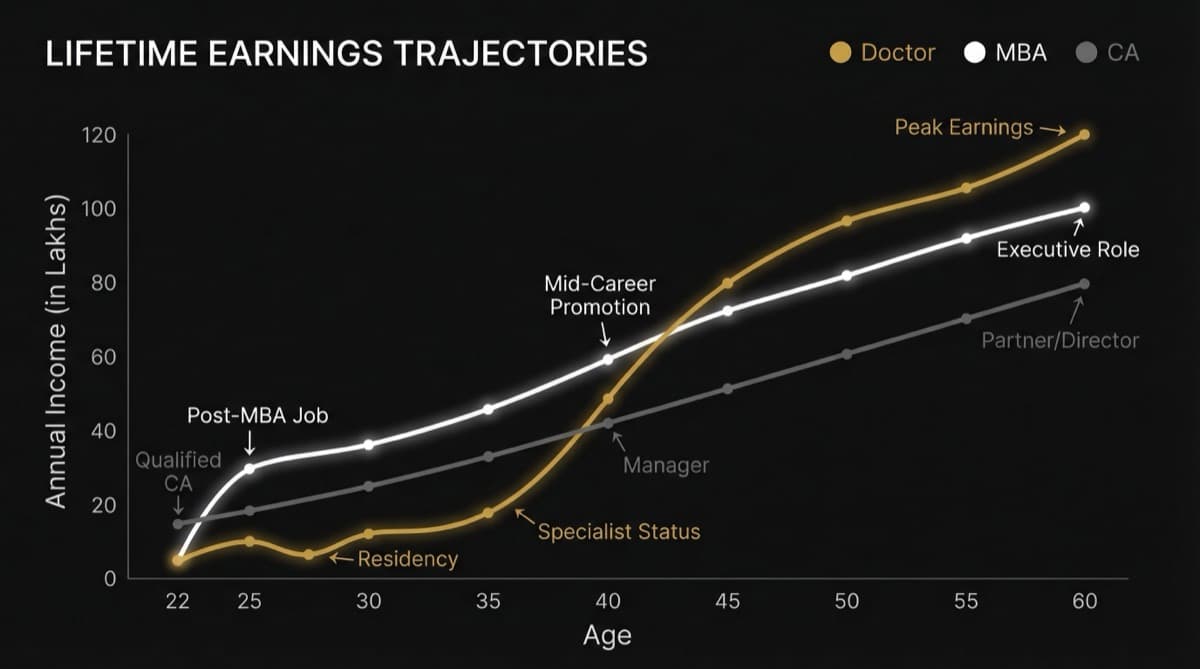
An MBBS doctor in India starts earning meaningful income at age 32 — a full 6-8 years after an MBA graduate from a top B-school hits Rs 20+ LPA and a CA starts pulling Rs 8-12 LPA at age 24. Over a 35-year career, a super-specialist doctor can out-earn both — but the total investment is 3x higher, the break-even comes a decade later, and the early-career financial gap creates a structural disadvantage that most doctors never fully recover from. Here's the complete, data-backed comparison.
When Does Each Career Path Start Earning?
The starting points differ dramatically. MBBS Doctor | 5.5 years + 1 year internship | 24 (internship stipend only) | Rs 40,000-90,000/month (private hospital) MBBS + PG (MD/MS) | 5.5 + 3 years PG | 27-30 | Rs 80,000-1,50,000/month (stipend during PG) MBBS + Super-specialty (DM/MCh) | 5.5 + 3 + 3 years | 30-33 | Rs 1,50,000-2,50,000/month MBA (Top B-school) | 4 years UG + 2 years MBA | 24 | Rs 20-35 LPA (Tier 1); Rs 10-18 LPA (Tier 2) MBA (Average B-school) | 4 years UG + 2 years MBA | 24 | Rs 6-10 LPA CA | 3-5 years (after 12th or during UG) | 22-24 | Rs 8-12 LPA (ICAI placement average: Rs 12.49 LPA)
The core structural disadvantage for doctors: While an MBA graduate from IIM-A is earning Rs 25 LPA at age 24, an MBBS graduate is earning Rs 50,000/month as a junior resident. By the time the doctor hits Rs 25 LPA (typically after PG completion at 28-30), the MBA peer has accumulated Rs 60-80 lakhs in total earnings. This early-career gap is the financial wound that compounds over a career.
What Is the Total Cost of Education for Each Path?
The cost asymmetry across paths is staggering. MBBS (Government) | Rs 2-5 lakhs total | 5.5 years | Rs 30-40 lakhs (vs working) | Rs 35-45 lakhs MBBS (Private) | Rs 50 lakhs - 1.5 crore | 5.5 years | Rs 30-40 lakhs | Rs 80 lakhs - 1.9 crore MBBS + PG | Add Rs 5-50 lakhs for PG | 8.5 years | Rs 50-70 lakhs | Rs 55 lakhs - 2.2 crore MBA (IIM) | Rs 20-30 lakhs | 2 years (after UG) | Rs 15-25 lakhs | Rs 35-55 lakhs MBA (Tier 2) | Rs 10-20 lakhs | 2 years | Rs 10-15 lakhs | Rs 20-35 lakhs CA | Rs 2-5 lakhs (coaching + fees) | 3-5 years | Rs 15-25 lakhs | Rs 17-30 lakhs
The cost asymmetry is staggering. A doctor from a private medical college with PG invests Rs 1.5-2.2 crore in education and opportunity cost. A CA invests Rs 17-30 lakhs. The doctor needs to earn Rs 1.5-2 crore more over their career just to break even on the educational investment difference.
How Do the Earning Curves Compare Year by Year?
The divergence starts immediately after education. Age 22-25: The MBA/CA Head Start
- MBA (Tier 1): Rs 20-35 LPA from day one. Some IIM-A/B/C graduates start at Rs 40-50+ LPA in consulting and finance
- CA: Rs 8-12 LPA starting. Top performers at Big 4 firms: Rs 15-20 LPA by year 2
- Doctor (MBBS): Still in medical college or earning Rs 50-80K/month as intern/junior resident. Net income after expenses: often negative (especially with educational loans)
Cumulative earnings gap by age 25:
- MBA (Tier 1): Rs 25-40 lakhs earned
- CA: Rs 15-25 lakhs earned
- Doctor: Rs 0-5 lakhs earned (stipends minus expenses)
Age 25-30: The Doctor Is Still Training
- MBA: Rs 14-25 LPA with promotions. Senior associates at consulting firms hitting Rs 30-40 LPA
- CA: Rs 15-30 LPA. Partners at mid-size firms. Industry CFO-track roles at Rs 25-40 LPA
- Doctor (PG resident): Rs 60-80K/month stipend. Working 100+ hours/week. Still technically "in training." Loan EMIs eating into stipend
Cumulative earnings gap by age 30:
- MBA (Tier 1): Rs 1.2-2 crore earned
- CA: Rs 80 lakhs-1.5 crore earned
- Doctor: Rs 20-40 lakhs earned (stipends over residency)
Age 30-35: The Doctor Finally Starts
- MBA: Rs 25-50 LPA in senior roles. VP/Director level at corporates
- CA: Rs 25-50 LPA. CFO roles opening up. Independent practice generating Rs 30-60 LPA
- Doctor (Post-PG): Finally earning real money. Specialists at Rs 15-30 LPA. Senior consultants beginning to hit Rs 30-50 LPA. Super-specialists starting practice building
This is the crossover zone. Doctors begin closing the cumulative gap — but it takes another 5-10 years to fully close it.
Age 35-45: The Doctor's Earning Peak
- MBA: Rs 40-80 LPA. C-suite roles at Rs 1-3 crore. But growth plateaus for most
- CA: Rs 40-80 LPA. Senior partners at firms. Industry C-suite roles
- Doctor (Established): This is where the curve changes. Established specialists: Rs 40-80 LPA. Super-specialists with strong practices: Rs 1-3 crore. Doctors with personal brands and procedures: earnings limited only by personal capacity
Age 45-60: The Long Game
- MBA: Peak earnings level off. Rs 50 LPA - 2 crore for top performers. Most plateau at Rs 50-80 LPA
- CA: Similar trajectory. Rs 50 LPA - 1.5 crore. Practice owners can exceed this
- Doctor: This is where doctors pull ahead — if they've built strong practices. Established super-specialists in metro cities earn Rs 1-3 crore annually. Surgeons with reputation-driven practices have no earnings ceiling. But this tier represents 10-15% of doctors, not the median
How Does the Lifetime Earnings Comparison Stack Up?
Over a full career, the picture is nuanced. Career earning years | ~28 years (age 32-60) | ~36 years (age 24-60) | ~36 years (age 24-60) Total education + opportunity cost | Rs 1-2.2 crore | Rs 35-55 lakhs | Rs 17-30 lakhs Lifetime earnings (median) | Rs 8-12 crore | Rs 8-15 crore | Rs 6-10 crore Lifetime earnings (top 10%) | Rs 25-50 crore | Rs 15-30 crore | Rs 10-20 crore Break-even vs MBA peer | Age 40-45 | Baseline | Age 35-40 Peak earning years | Age 40-55 | Age 35-50 | Age 35-50 Income ceiling | Functionally unlimited (top surgeons) | Capped by corporate hierarchy | Capped by firm/practice size
The key insight: At the very top, doctors out-earn both MBAs and CAs. But the median doctor earns comparable or less than the median MBA over a lifetime — after investing 3x more in education and starting 8 years later. The doctor's career is a high-risk, high-reward, delayed-return investment.
What Are the Hidden Costs Nobody Talks About?
Each career path has costs that don't show up in salary comparisons. For Doctors
- Decade of financial vulnerability: Ages 22-32 are spent in training with minimal income, while peers build assets, invest, and compound returns
- Health cost of training: 100-hour weeks during residency have long-term physical and mental health consequences that have financial implications
- Continuous investment: Equipment, clinic setup, CME requirements, and insurance add ongoing costs that MBAs and CAs don't face
- No passive income path: A doctor's income is directly tied to their physical presence and clinical work. An MBA can earn equity, stock options, and passive income through corporate structures
For MBAs
- Ceiling effect: Corporate hierarchies cap earnings. Very few MBA graduates become CEOs earning Rs 5+ crore. Most plateau at Rs 40-80 LPA
- Job insecurity: Corporate layoffs, industry disruptions, and economic cycles create income volatility that salaried doctors don't face
- Golden handcuffs: Stock options and deferred compensation create lock-in that limits career flexibility
For CAs
- Partnership track: The real money in CA is in partnerships — but securing one takes 10-15 years and depends on business development, not just technical skill
- Compliance burden: CA practice requires staying current with constantly changing tax law, regulatory changes, and compliance requirements
- Scale limitations: A CA practice has natural scale limits unless you build a firm — which requires different skills than accounting
What Does This Earnings Comparison Mean for You?
If you're a medical student or young doctor reading this, the comparison isn't about whether you made the wrong choice. It's about understanding the financial architecture of your career so you can make better decisions within it.
Three structural realities to internalize:
First, your earning curve starts late. This means every financial decision before age 35 matters disproportionately — managing educational debt, avoiding lifestyle inflation, and beginning SIP investments even during residency.
Second, your income ceiling is high but not guaranteed. The doctors earning Rs 1-3 crore are those who built practices, patient relationships, and professional reputations. The median doctor earns Rs 30-50 LPA — respectable, but not the outlier figures people cite.
Third, the comparison is most useful for the next generation. If you're advising a 17-year-old choosing between NEET and CAT preparation, the honest answer is: medicine is a calling that happens to have a career attached. If the primary motivation is financial returns, the ROI math favours MBA and CA paths.
Frequently Asked Questions
Do doctors earn more than MBAs in India? At the top of the distribution, yes — super-specialists can earn Rs 1-3 crore annually, exceeding most MBA salaries. At the median, it's roughly comparable (Rs 30-50 LPA for established specialists vs Rs 30-60 LPA for senior MBA professionals). But doctors start earning 8 years later and invest 3x more in education, making the risk-adjusted return lower.
At what age do doctors start earning more than MBA peers? Doctors typically close the cumulative earnings gap with MBA peers around age 40-45 — approximately 15-20 years after the MBA peer started earning. Super-specialists may close it slightly earlier; general practitioners may never fully close it.
Is MBBS worth it financially in 2026? If you attend a government medical college (Rs 2-5 lakhs total cost), the financial return is strong — eventually. If you attend a private medical college (Rs 50 lakhs-1.5 crore), the financial math is challenging unless you pursue a high-earning specialty and build a successful practice. The honest answer: medicine is financially worth it for the top 20-30% of practitioners.
Why are doctor starting salaries frozen in India? Supply-side expansion (MBBS seats grew from 49,000 to 1,18,000) meets demand-side consolidation (fewer large employers with more hiring power). When 1,18,000 graduates compete for positions at a limited number of hospitals, starting salary stays at Rs 40-60K/month regardless of inflation.
Should I do an MBA after MBBS? An MBA adds 2 years and Rs 15-30 lakhs but opens doors to healthcare management, consulting, pharma leadership, and health-tech roles paying Rs 20-40 LPA immediately — without the decade-long practice-building phase. It makes financial sense for doctors who don't want to build clinical practices but want healthcare-adjacent careers.
futurise. builds premium healthcare brands in 48 hours. Learn more at futurise.studio