On this page
Different Stages, Different Strategies (And Most Doctors Miss It)
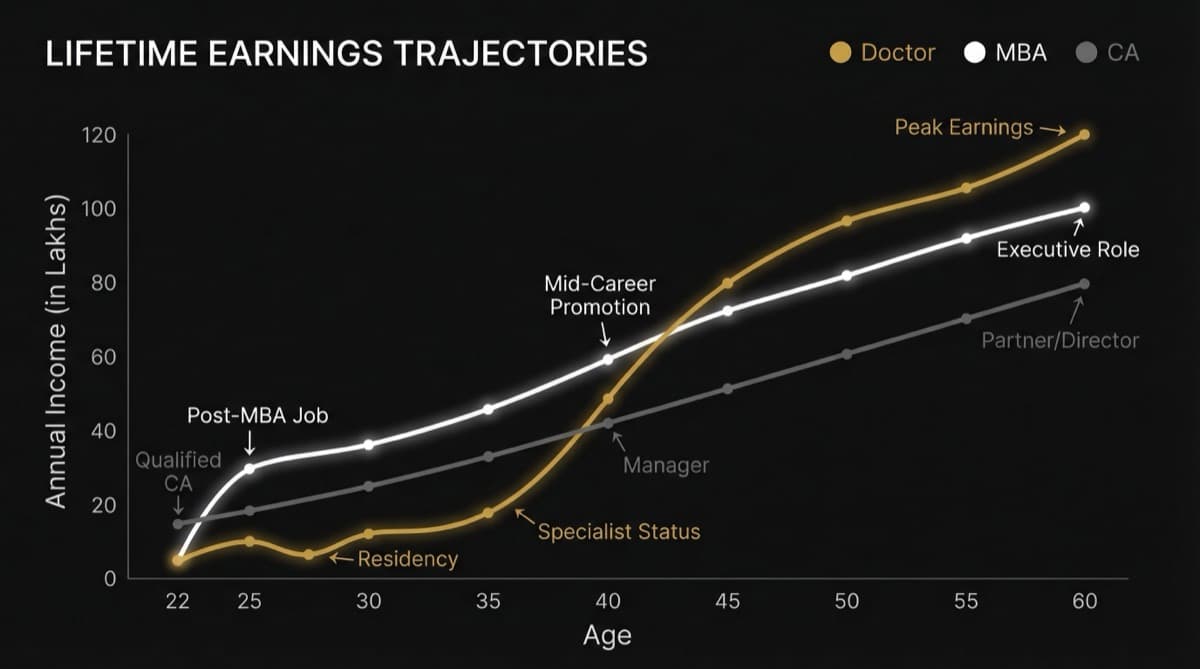
Your financial priorities at age 30 (residency) are not the same at 40 (established practice) or 55 (pre-retirement). Most doctors use the same savings strategy for 30 years and wonder why they're broke at 65. Here's the structural breakdown of what each stage requires.
Q.What Is Structural Mechanism 1: Four Stages of Doctor Income and Strategy?
| Stage | Age Range | Income | Leverage | Financial Priority | Strategy | Annual Savings Target | Typical Failure |
|---|---|---|---|---|---|---|---|
| Stage 1: Residency | 25-32 | Rs 8-15L/year | High (human capital) | Build emergency fund; start compounding; marry well (dual income) | 20% savings + marriage planning | Rs 2-3L/year | Stop saving after residency starts; think earnings are unlimited |
| Stage 2: Early Practice | 32-40 | Rs 25-40L/year | Medium-High (practice stability) | Eliminate debt; buy primary home; start serious investing | 30% savings + home purchase + equity market | Rs 8-12L/year | Buy expensive home; delay equity investing; save in low-return vehicles |
| Stage 3: Established Practice | 40-50 | Rs 50-100L/year | Medium (income less dependent on years, more on reputation/network) | Maximize tax-advantaged investing; build wealth diversification; fund kids' education | 35-40% savings + tax optimization + real estate (secondary only) | Rs 18-40L/year | Lifestyle inflation; unnecessary 2nd/3rd properties; under-investing in equity |
| Stage 4: Pre-Retirement | 50-60+ | Rs 80-150L/year | Low (human capital declining; practice dependent on reputation/patient loyalty) | Preserve capital; reduce active income risk; transition to passive income | 40-50% savings + shift to fixed income; minimal property | Rs 32-75L/year | Over-aggressive investing; not reducing volatility; panic selling during downturns |
What this means: Stage 1 is about starting compound growth (small amounts at high growth periods = massive returns). Stage 2 is about debt elimination and wealth acceleration (income scales faster than expenses). Stage 3 is about tax optimization and wealth concentration (income peaks; focus on keeping more of it). Stage 4 is about capital preservation and passive income transition (income declining; need stable base). Most doctors stay in Stage 2 strategy their entire life (20% savings, low-return vehicles, basic investing).
Q.What Is Structural Mechanism 2: Stage 1 Residency (Age 25-32): Building the Foundation?
| Financial Task | Why It Matters | What to Do | Cost | Timeline |
|---|---|---|---|---|
| Emergency Fund | Residency is low-income, unstable; one illness = financial crisis | Save 6 months expenses (Rs 3-4L) in liquid savings | Cost: opportunity (not invested in market) | By end of Year 2 of residency |
| Start Equity Investing | Early years compound the longest; Rs 1L at 25 becomes Rs 15Cr by 65 at 10% CAGR | Index fund SIP (Systematic Investment Plan) of Rs 5-10K/month | Cost: zero (automatic deduction) | Start Year 1 of residency; never stop |
| Marriage Planning | Dual income is massive advantage (two Rs 15L earners = Rs 30L household at age 30) | Marry someone employed; prioritize income + stability over family connections | Cost: depends on family | Age 28-32 is optimal (early enough to benefit from dual 20 years, late enough to be established) |
| Debt Elimination | Student loans from medical school compound against you; remove interest burden | Refinance at lower rate or prepay aggressively using 50% of salary increases | Cost: Rs 20-40L (payoff by age 32) | Pay off by age 32; after that focus on assets, not debt payoff |
| Insurance (Term Life) | If you marry/have dependents, need coverage in case of death; pure term is cheapest | Buy 20x annual income term insurance (age 30, Rs 20L coverage = Rs 10-15K/year premium) | Cost: Rs 10-15K/year | Immediately after marriage |
| Home Rent vs. Buy Decision | At low income, buying is financing burden; renting is flexibility | Rent until income stabilizes (Stage 2). Buy after emergency fund + down payment (20%) saved. | Cost: don't overspend on rent | Delay home buying until Stage 2 (income Rs 25-30L+) |
Reading this table: Stage 1's goal is compound growth (start equity SIP, don't touch it for 30 years) + building safety net (emergency fund + insurance). Most doctors skip this (no emergency fund, no investing, delayed insurance). By delaying equity investing by 5 years (starting at 30 instead of 25), you lose Rs 3-5Cr in final wealth.
Q.What Is Structural Mechanism 3: Stage 2 Early Practice (Age 32-40): Wealth Acceleration?
| Financial Task | Why It Matters | What to Do | Cost | Outcome |
|---|---|---|---|---|
| Debt Elimination | Carry-forward debt from residency or education; blocks wealth building | Eliminate all non-real-estate debt by age 40; refinance home loan to longest tenure (25 years) | Cost: Rs 5-15L total (aggressive payoff) | Debt-free except mortgage by age 40; Rs 1000s/month freed up for investing |
| Home Purchase | Primary residence is necessity (not investment); lock in 25-year mortgage at age 35 | Buy Rs 40-60L home (based on city); 20% down payment (Rs 8-12L); 25-year mortgage at 7.5% interest | Cost: Rs 8-12L down payment; Rs 3-4L/year mortgage EMI | Own home by age 40; mortgage becomes fixed (doesn't inflate with income) |
| Aggressive Equity Investing | Income is rising (Rs 25L → Rs 40L); market is volatile (corrections are buying opportunities) | Increase SIP to Rs 30-50K/month; add lump-sum investment during market corrections (March 2020, Oct 2022 levels) | Cost: Rs 30-50K monthly | By age 40, Rs 50-75L invested in equity; growing at 10%+ CAGR |
| Debt vs. Investment Trade-off | Some doctors overpay mortgage (Rs 10L/year) to own home early; locks up capital | Pay mortgage on schedule (don't prepay); invest extra in equity (higher returns) | Opportunity cost: home equity vs. market equity | By age 40, equity portfolio of Rs 75L growing faster than mortgage payoff |
| Life Insurance Increase | If married with kids, coverage need increases; balance pure term with investment | Increase term coverage to 30x income; buy once (at age 35, coverage locked until age 65) | Cost: Rs 20-30K/year for Rs 1Cr+ coverage | Protected until age 65; kids' education funded if tragedy strikes |
| Tax-Advantaged Investing | Income increased; tax rate increasing; tax planning now matters | Max out NPS (National Pension Scheme) contributions (Rs 50-80K/year); use Section 80C deductions | Cost: Rs 50-80K additional savings | Tax saving: Rs 12-24K/year × 10 years = Rs 1.2-2.4L saved in taxes |
What this means: Stage 2 is about building wealth velocity (aggressive equity investing + increasing SIPs) while locking in fixed costs (home mortgage). Most doctors make mistakes: overpay on homes (Rs 15-20L down payment, prepaying mortgage), delaying equity investing (thinking "I'll invest once home is paid off"), or undersaving (continuing 20% savings rate from Stage 1). Correct approach: 20% down on home, 25-year mortgage, 30% savings in aggressive equity, plus tax optimization.
Structural Mechanism 4: Stage 3 Established Practice (Age 40-50): Tax Optimization and Wealth Concentration
| Financial Task | Why It Matters | What to Do | Cost | Outcome |
|---|---|---|---|---|
| Tax Planning | Income peaked (Rs 50-100L); marginal tax rate now 42-45%; every rupee saved = major impact | HUF structure (if applicable), corporate structure (Rs 30-50L income), expense optimization, investment deductions | Cost: Rs 20-50K/year professional advice | Tax saving: Rs 5-20L/year on income; Rs 50L-1Cr saved over 10 years |
| Lifestyle Cost Lock-in | Expenses have inflated (housing, kids' education, lifestyle); difficult to reduce | Acknowledge lifestyle = locked cost; don't increase further; kids' education peak spending (Rs 15L/year) will end at age 50 | Cost: discipline (refuse to upgrade home, cars) | By age 50, freed Rs 20L/year as kids finish education; can redirect to investing |
| Kids' Education Funding | Peak expense years (ages 40-50 for kids aged 10-20); education costs rising 12-15% annually | Fund kids' higher education (college, professional courses); expect Rs 30-50L per child (India + maybe 1 year abroad) | Cost: Rs 50-100L total for 2 kids | By age 50, education costs drop to near-zero; massive cashflow freed |
| Secondary Real Estate Decision | Many doctors buy 2nd property thinking "investment"; property appreciates 4-5% real | Avoid 2nd property unless you have specific reason (rental income in secure location). Equity funds out-perform (8-10% real). | Cost avoidance: don't tie up Rs 50-100L in property; keep in equity | Additional wealth: Rs 30-50L extra by age 65 (difference in returns) |
| Wealth Diversification | By age 45, you have Rs 1-2Cr invested in equity; concentrated risk is high | Diversify: keep 60-70% equity, add 20-30% fixed income (bonds, gilt), 10% real estate (primary home) | Cost: opportunity (fixed income yields less than equity) | Protection: if equity market corrects 30%, your wealth is only down 20% (not 30%) |
| Succession & IP Planning | If you have a clinic/practice, what happens if you die or get incapacitated? | Document practice valuation, client list, staff responsibilities; create operating manual; consider buy-sell agreement with partner | Cost: Rs 50-100K legal + documentation | Upon death/incapacity, family or partner can run practice or sell for fair value (not distressed) |
Reading this table: Stage 3 is about keeping more of what you earn (tax optimization) and building wealth concentration (moving beyond equity SIP to tax-advantaged vehicles, diversification). Mistakes: buying 2nd/3rd property, not doing tax planning (underestimating impact), over-spending on kids' education (private school, international coaching when government school works).
Structural Mechanism 5: Stage 4 Pre-Retirement (Age 50-60+): Capital Preservation and Income Transition
| Financial Task | Why It Matters | What to Do | Cost | Outcome |
|---|---|---|---|---|
| Shift to Fixed Income | Equity market volatility is high; at age 50, recovery from downturns takes 5-10 years; you don't have 10 years left | Rebalance portfolio: reduce equity from 70% to 50%; increase fixed income (bonds, gilt, FD) to 40%; keep 10% alternative | Cost: lower returns (7% vs. 10% in equity) | Stability: if market crashes 30%, your wealth only drops 15% (portfolio protected) |
| Evaluate Clinic Valuation | If you own clinic/practice, value it; decide: sell at 50-55 to enjoy pre-retirement, or continue until 60-65? | Get clinic valued (Rs 50-200L depending on size, location, earnings); decide exit timing based on valuation | Cost: Rs 30-50K valuation | If you sell at 55 for Rs 100L, that's Rs 5-10L/year passive income (instead of working full-time) |
| Transition to Passive Income | Work income will decline (age 55+, patient volume drops, burnout increases); need passive income base | Build passive income: rental property, dividend stocks, advisory retainers, course/content revenue, consulting | Cost: Rs 10-20L investment for Rs 50-100K/month passive | By age 60, Rs 50-100K monthly passive income = Rs 6-12L annual base; supplement with part-time consulting |
| Reduce Work Hours | Full-time practice at age 55 = burnout risk; reduce to part-time (3 days/week), build passive income base | Negotiate with hospital/practice partners: shift to part-time, mentoring, advisory roles | Cost: income reduction (40-50%) | Psychological: more time for health, family; financial: offset by passive income + reduced lifestyle spend |
| Healthcare Insurance Review | Current health insurance expires at age 65 (many policies); need long-term care coverage for age 65-80+ | Buy senior health insurance (age 55+, covers age 65+ gaps); consider critical illness rider | Cost: Rs 20-30K/year for comprehensive coverage | Medical expense at age 70 = Rs 10L+ (cancer, heart disease); insurance covers Rs 8-10L |
| Estate Planning & Succession | Kids are adults (age 20-30); grandkids likely born; will & succession documents outdated | Update will, beneficiary designations (insurance, bank accounts); discuss with kids; appoint executor | Cost: Rs 20-30K legal documentation | Upon death, family knows your wishes; succession is clear; legal disputes avoided |
What this means: Stage 4 is about converting high-work income to low-work passive income. Most doctors fail here: they keep working 100% until age 65 (burnout), then try to retire cold turkey (adjustment crisis). Correct approach: reduce work at 55-58 (shift to part-time), build passive income parallel, retire at 60-62 with 50-70% of previous income from passive sources.
Need help with this?
Our team specializes in healthcare branding. Get personalized advice in a free 15-minute call.
Book a free 15-minute callFrequently Asked Questions
Q: At which age should I shift from aggressive equity to conservative fixed income?
A: Age 50 (Shift from 70-80% equity to 60% equity + 30% fixed + 10% alternative). Age 55 (Shift to 50% equity + 40% fixed). Age 60 (Shift to 40% equity + 50% fixed + 10% alternative). The rule: keep equity allocation = (110 - your age). At 50, that's 60% equity. At 60, that's 50% equity. This de-risks gradually as you approach retirement.
Q: Should I buy a 2nd home at age 45 for my kids to live in later?
A: Only if you have: (1) excess capital (after tax-advantaged investing is maxed), (2) 30%+ down payment saved, (3) location appreciation track record >6% annually, (4) positive rental yield (if you plan to rent to others). Most doctors should NOT buy 2nd property. The expected value of equity (8-10% returns) exceeds property (4-5% real returns) for pure investment. Property makes sense only if you have emotional/family reasons or want to diversify (and only then, after maxing equity investing).
Q: Is it too late to start serious investing at age 40?
A: No, but you need to increase savings rate. At 40, you have 25 years to retire at 65. If you save Rs 30L/year (60% of Rs 50L income) for 25 years at 8% returns, you'll have Rs 100Cr. That's sufficient. If you save Rs 15L/year (30%), you'll have Rs 50Cr (tight). You've lost the early compounding advantage, so higher savings rate now is required to compensate. Most doctors can afford 35-40% savings at age 40-50 (if they control lifestyle inflation).
futurise. builds premium healthcare brands in 48 hours. Learn more at futurise.studio