When a hospital merges or gets acquired in India, doctor employment contracts change in five predictable ways: revenue-share models shift to fixed salary, non-compete clauses get tighter, throughput metrics replace clinical freedom, package rates replace fee-for-service billing, and administrative oversight increases. These changes follow a structural pattern driven by EBITDA optimization — understanding them before they happen gives you negotiating leverage.
Why Are Hospital Mergers Accelerating Right Now?
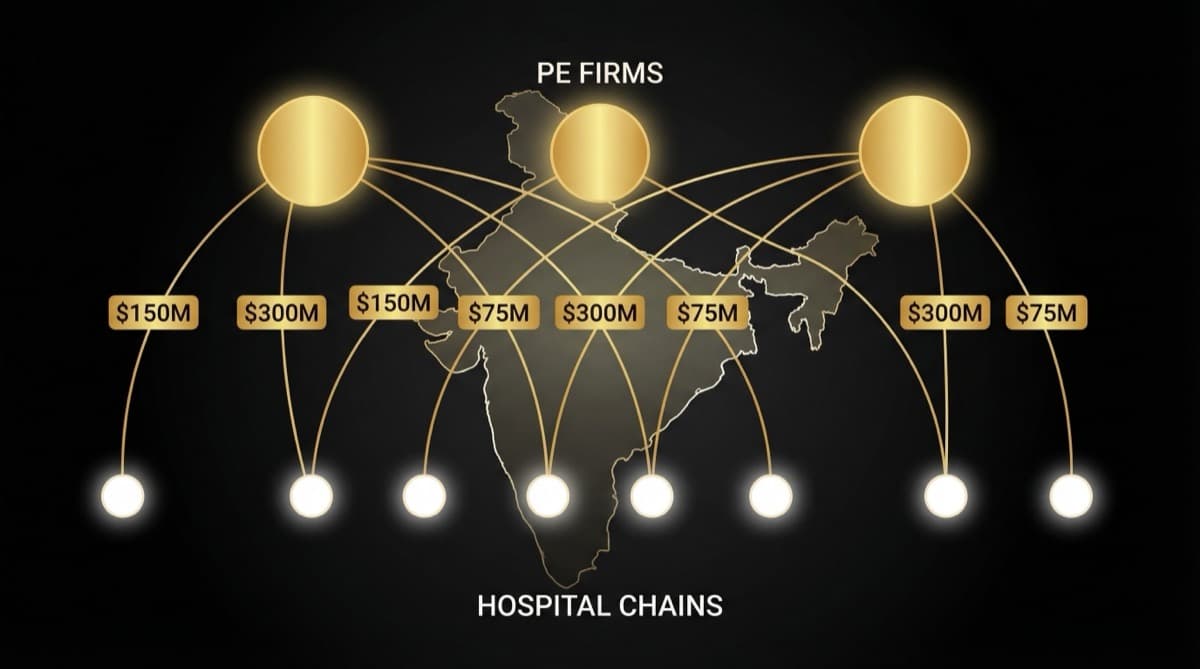
Between 2022 and 2024, Indian hospitals saw $4.96 billion in PE acquisitions and $6.74 billion in M&A deals. The merger of Aster DM, Care Hospitals, KIMS Health, and Evercare into a single $5 billion platform. Temasek's $2 billion acquisition of Manipal, followed by Manipal absorbing AMRI and Sahyadri. KKR acquiring HCG from CVC Capital for $400 million.
Each of these transactions affects thousands of doctor contracts. When Blackstone merges Care Hospitals, KIMS, and Aster India into one platform spanning 38 hospitals and 10,150 beds, the contract standardization that follows isn't optional — it's the operational logic of the acquisition.
What Are the Five Contract Changes That Follow Every Hospital Merger?
Every hospital merger triggers five predictable contract changes. 1. Revenue-Share Becomes Fixed Salary + Variable Pay
Before merger: Senior consultants typically earn 30-60% of billings generated from their patients. A cardiologist performing 15 procedures monthly might take home Rs 8-15 lakhs, with no ceiling on earnings.
After merger: The new entity introduces "standardized compensation bands." Your revenue-share becomes a fixed salary of Rs 2-5 lakhs/month plus "performance incentives" tied to hospital-defined metrics. These metrics are bed occupancy rates, discharge turnaround, and ARPOB (Average Revenue Per Occupied Bed) — not your clinical billings.
Why it happens: Revenue-share creates variable costs that make EBITDA unpredictable. PE firms paying 15-28x EBITDA need margin certainty. Converting variable doctor costs to fixed costs (with capped bonuses) makes the financial model predictable.
What to watch for: The new contract may frame this as a "guaranteed minimum" — implying it's better than variable income. Calculate your actual earnings under both models before signing.
- 1Non-Compete Clauses Get Tighter and More Specific
Before merger: Many doctor-promoter hospitals either don't have non-compete clauses or have loosely worded ones that are rarely enforced.
After merger: The new contract typically includes a non-compete clause restricting you from practicing within a 10-15 km radius for 1-2 years after leaving. Some extend to 25 km in metros and include restrictions on joining competing hospital chains.
Legal reality in India: Non-compete clauses in employment contracts face enforceability challenges under Section 27 of the Indian Contract Act, which declares agreements in restraint of trade void. However, courts have sometimes upheld "reasonable restrictions" — and the ambiguity itself creates a chilling effect. Most doctors don't want to risk litigation even if they'd win.
What to watch for: Look for "non-solicitation" clauses buried alongside non-competes. These prevent you from contacting patients you treated at the hospital — a more practically damaging restriction than geographic limits.
- 1Throughput Metrics Replace Clinical Autonomy
Before merger: You decide how many patients to see, how long each consultation takes, and which procedures to recommend based on clinical judgment.
After merger: Hospital management introduces scheduling optimization. Your OPD slots are fixed. Consultation time is targeted (typically 10-15 minutes). Your "productivity" is measured against KPIs: patients seen per day, bed occupancy of your assigned beds, average length of stay, and discharge rates.
Why it happens: A hospital operating at 65% bed occupancy generates significantly less revenue than one at 80%. Mergers are designed to lift occupancy across the combined network — and that requires managing doctor schedules as operational inputs, not clinical preferences.
The structural impact: When your schedule is managed for throughput, you don't control your most valuable professional asset — your time. The hospital captures the efficiency gain, not you.
- 1Package Rates Replace Fee-for-Service
Before merger: You bill individually for consultations, procedures, follow-ups, and investigations. Each service has a separate charge negotiated between you and the hospital.
After merger: Procedures get bundled into standardized packages. A knee replacement that you previously billed as consultation + pre-op + surgery + follow-ups (totaling Rs 3-4 lakhs in doctor fees) becomes a single package where the hospital allocates Rs 1.5-2 lakhs to doctor compensation.
Why it happens: Package pricing makes costs predictable for insurance companies (which represent a growing share of hospital revenue) and for PE firms modeling future EBITDA. It also makes doctors interchangeable — if the package rate is fixed, any qualified surgeon can perform it.
What to watch for: Package rates almost always reduce total doctor compensation per procedure. The hospital's response will be: "but you'll do more volume." Calculate whether the volume increase actually compensates for the per-procedure reduction.
- 1Administrative Oversight Increases Dramatically
Before merger: Clinical decisions — which tests to order, which treatment protocol to follow, which equipment to use — are made by you with minimal administrative interference.
After merger: A layer of non-clinical administration appears between you and your patients. Treatment protocols require pre-authorization. Equipment purchases go through procurement committees. Referral patterns are monitored. Even your prescription patterns may be reviewed against "clinical efficiency" benchmarks.
Why it happens: PE firms run hospitals as businesses with business controls. Variance in clinical practice is variance in cost. Standardization reduces cost unpredictability.
When Do Contract Changes Actually Hit After a Merger?
Changes follow a predictable timeline. Announcement | Day 0 | "Nothing will change" messaging. Existing contracts honoured Transition | Month 1-6 | New management assesses operations. No contract changes yet Standardization | Month 6-12 | New contract templates introduced. "Voluntary" migration to new terms Enforcement | Month 12-18 | Remaining old contracts renegotiated or not renewed. Clear signal to accept or leave New Normal | Month 18+ | All doctors on standardized contracts. Senior departures replaced with junior hires
How Can You Protect Yourself During a Hospital Merger?
Before signing anything new:
- Calculate your actual income under the current model for the last 12 months
- Compare it honestly against what the new contract offers (including best-case incentive scenarios)
- Have a lawyer review the non-compete and non-solicitation clauses specifically
- Ask for the specific KPIs that will determine your variable pay — get them in writing
Build leverage before you need it:
- Patient loyalty to you (not the hospital brand) is your primary negotiating asset
- Maintain your own professional presence — your own website, your own content, your own referral network
- Document your contribution to hospital revenue with specifics
Know your options:
- If demand exceeds supply in your specialty and geography, you have more leverage than you think
- If you're in a commoditized specialty with excess supply, focus on the long game — build the patient relationships that make you irreplaceable
Frequently Asked Questions
Can a hospital change my contract after a merger without my consent? Legally, no — your existing contract remains valid. But practically, hospitals introduce "new standardized contracts" and strongly encourage migration to new terms. Refusal may result in your contract simply not being renewed when it expires, or being sidelined in scheduling and patient allocation.
Are non-compete clauses in doctor contracts enforceable in India? They face significant enforceability challenges under Section 27 of the Indian Contract Act, which voids agreements in restraint of trade. However, courts have sometimes upheld "reasonable restrictions," and the legal ambiguity creates practical deterrence. Most doctors don't want the cost and stress of litigation.
How much do doctors typically lose in a merger? Senior consultants on revenue-share models typically see a 20-35% reduction in total compensation over 12-18 months post-merger. The reduction comes not from salary cuts but from the structural shift to fixed-plus-variable models where the variable component has lower ceilings than the old revenue-share.
Should I leave before or after a merger completes? If you have strong patient loyalty and your specialty is in demand, leaving during the transition period (months 0-6) gives you the most leverage — the acquiring entity doesn't want visible doctor attrition. If you lack these, staying and negotiating the best possible terms under the new structure may be pragmatic.
Do mergers affect government hospital doctors differently? Government hospital mergers (rare but increasing through PPP models) affect doctors differently — compensation is typically protected by government pay scales, but clinical autonomy and administrative structure can change significantly when private management takes operational control.
futurise. builds premium healthcare brands in 48 hours. Learn more at futurise.studio