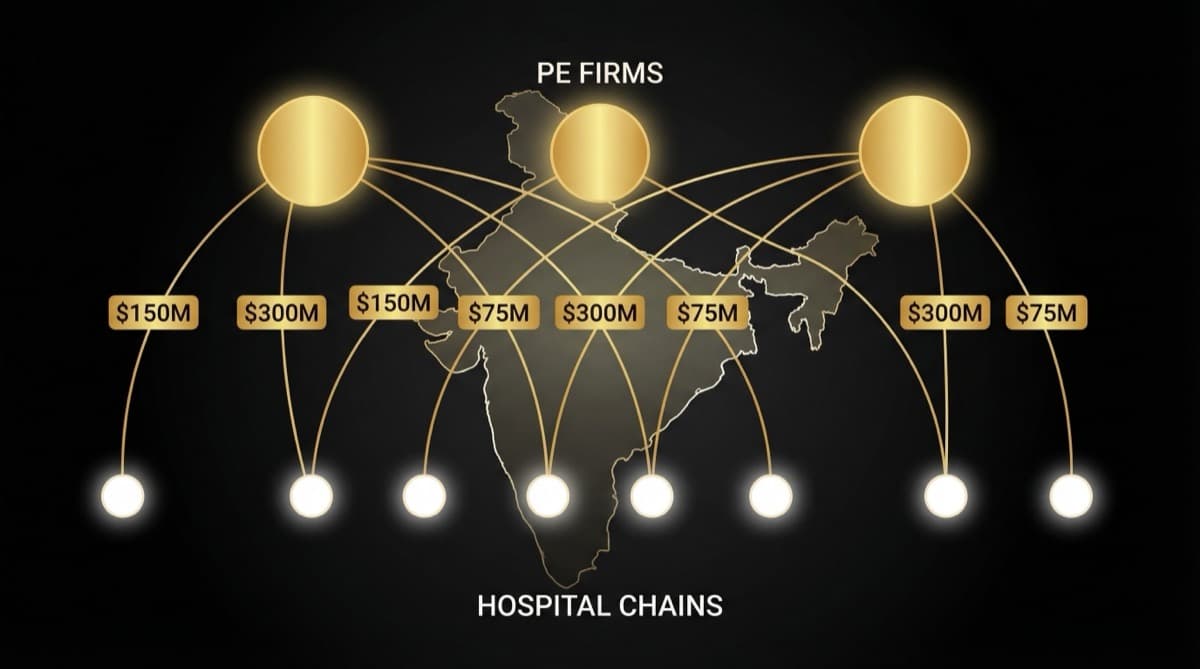
Yes, corporate hospitals in India are systematically replacing senior consultants with junior doctors — and it's not accidental. It's a direct consequence of PE-driven EBITDA optimization. A senior surgeon earning Rs 12 lakhs/month in revenue-share gets replaced by two junior consultants at Rs 3-4 lakhs each. Same bed utilization, same procedure volume, half the doctor cost. Hospital EBITDA margins have risen from 10-15% to 25-30% across PE-backed chains, and this substitution is one of the core mechanisms driving that margin expansion.
What Is the Financial Logic Behind Replacing Senior Doctors?
To understand why this is happening, you need to understand one number: staff costs represent approximately 50% of a hospital's total operational costs. Doctor fees and salaries are the largest controllable expense.
When PE firms acquire hospitals at 15-28x EBITDA and target exit at even higher multiples, every percentage point of margin improvement translates to crores in enterprise value. The math is simple:
Doctor cost per month | Rs 12 lakhs (revenue-share) | Rs 6-8 lakhs (two juniors, fixed salary) Procedures per month | 15-18 | 15-20 (two doctors, same total) Annual doctor cost savings | — | Rs 48-72 lakhs per senior replaced EBITDA impact at 20x multiple | — | Rs 9.6-14.4 crore in enterprise value per senior replaced
Multiply this across 50-100 senior consultants in a large hospital chain, and the enterprise value impact runs into hundreds of crores. This is why PE-backed hospitals view senior consultant replacement not as a clinical decision, but as a financial optimization.
How Does the Replacement of Senior Doctors Actually Happen?
Corporate hospitals don't fire senior consultants outright — that would cause visible attrition and reputational damage. Instead, they use a three-step structural process:
Step 1: Contract Renegotiation (Month 6-12 Post-Acquisition)
The hospital introduces new "standardized compensation bands." Senior consultants earning Rs 10-15 lakhs/month through revenue-share are offered fixed salary contracts at Rs 3-5 lakhs/month plus performance incentives. The ceiling on total compensation drops significantly.
Many seniors refuse these terms. That's not a bug — it's a feature of the strategy.
Step 2: Passive Attrition (Month 12-18)
Senior consultants who don't accept new terms find their environment changing. Scheduling gets managed centrally. Patient allocation shifts. Referral patterns are redirected toward "hospital departments" rather than individual doctors. Administrative support decreases.
The message is clear without being explicit: the hospital values the brand, not the individual doctor. Seniors who can leave, do.
Step 3: Junior Recruitment (Month 12-24)
Simultaneously, the hospital aggressively recruits junior specialists — doctors with 2-5 years post-PG experience who are clinically competent but have limited patient followings. These doctors are hired on fixed salary contracts at Rs 2-4 lakhs/month with no revenue-share component.
The juniors are grateful for the opportunity. The hospital gets competent clinical work at a fraction of the cost.
Why Do Junior Doctors Accept These Lower Terms?
The supply-demand reality of Indian medicine makes this possible:
- 1,18,000 MBBS seats produce graduates every year — a number that has more than doubled from 49,000 seats in the last decade
- Fresh MBBS doctors earn Rs 40,000-90,000/month in private hospitals — salaries that haven't meaningfully increased in a decade
- PG completion happens at age 27-30, meaning doctors enter the independent-practice market with zero savings and often significant educational debt
- The alternative for many juniors is unemployment, low-paying small-town positions, or years of unpaid fellowship work
When a corporate hospital offers a junior specialist Rs 3 lakh/month with a fixed salary, air-conditioned OPD, and the brand prestige of a major chain — the offer is genuinely attractive compared to their alternatives.
The structural problem isn't that juniors are unqualified. They're clinically trained and capable. The problem is that the system uses their economic vulnerability to compress doctor compensation across the board.
What Does This Substitution Mean for Senior Consultants?
If you're a senior consultant in a corporate hospital, the substitution risk depends on three factors:
- 1Patient Stickiness
If patients come for the hospital brand, you're replaceable. If they come specifically for you — seeking you by name, following you across locations — you have leverage the hospital can't easily eliminate.
- 1Specialty Replaceability
In specialties with abundant supply (general surgery, general medicine, obstetrics in metros), replacement is easy. In specialties with genuine scarcity (certain sub-specialties of oncology, cardiothoracic surgery, complex neurosurgery), the hospital cannot easily find a junior substitute.
- 1Revenue Concentration
If you generate a disproportionate share of your department's revenue — say, 40-50% of cardiac surgery billings — replacing you means losing that revenue, at least temporarily. The hospital calculates whether the cost saving exceeds the revenue risk.
What Does This Substitution Mean for Junior Doctors?
The corporate substitution model creates a paradox for junior doctors:
Short-term win: More job opportunities, better facilities, named-brand hospitals on your CV, and stable fixed income compared to alternatives.
Long-term trap: You enter a system designed to keep your compensation fixed while maximizing your output. The revenue-share model that allowed previous generations of doctors to build wealth is being structurally eliminated — by the time you become "senior," the compensation ceiling has been permanently lowered.
The doctors who built Rs 50 lakh+ annual incomes through revenue-share in the 2000s and 2010s operated in a structurally different market. The PE-optimized hospital of the 2020s is designed to capture that upside for shareholders, not for doctors.
What Is the Broader Impact of Doctor Substitution on Indian Healthcare?
This substitution has effects beyond individual doctor paychecks:
Clinical experience concentration decreases. When hospitals replace 20-year veterans with 3-year post-PGs, the aggregate clinical experience in the building drops. For complex cases, this matters.
Training quality suffers. Senior consultants are the primary teachers of medical residents and fellows. When they leave corporate hospitals, the teaching function goes with them — or gets replaced by protocol manuals.
Patient trust erodes gradually. Patients who built relationships with senior consultants over years find themselves seeing rotating junior doctors. The hospital maintains continuity of brand, but the patient-doctor relationship — which drives adherence, satisfaction, and outcomes — gets disrupted.
Frequently Asked Questions
Are corporate hospitals deliberately pushing out senior doctors? Not through explicit termination — that would create legal and reputational risk. Instead, contract renegotiations with significantly lower compensation, centralized scheduling that reduces autonomy, and redirected patient allocation create an environment where seniors choose to leave. The end result is the same.
Is this happening across all specialties? It's most aggressive in specialties with high supply and standardizable procedures — general surgery, orthopedics, obstetrics, and general medicine in metro cities. It's less prevalent in scarce sub-specialties where junior replacements simply aren't available.
Can junior doctors eventually earn what seniors earned? Under the current PE-backed model, it's structurally unlikely. Revenue-share models are being eliminated. Fixed-salary-plus-incentive models have built-in ceilings. The path to high doctor income increasingly requires building an independent practice — which is exactly what non-compete clauses are designed to prevent.
What can senior doctors do to protect themselves? Build patient relationships that are personally sticky — patients who follow you, not the hospital. Maintain an independent professional presence (website, content, referral network). Consider ownership models (clinics, medical centres) where you capture the enterprise value, not just the salary.
Is this good or bad for patients? Mixed. Patients get access to competent care at hospitals with better infrastructure. But they lose continuity with experienced doctors who know their history, and the pressure on junior doctors to maintain throughput can affect consultation quality. Complex cases that benefit from decades of experience are the most affected.
futurise. builds premium healthcare brands in 48 hours. Learn more at futurise.studio