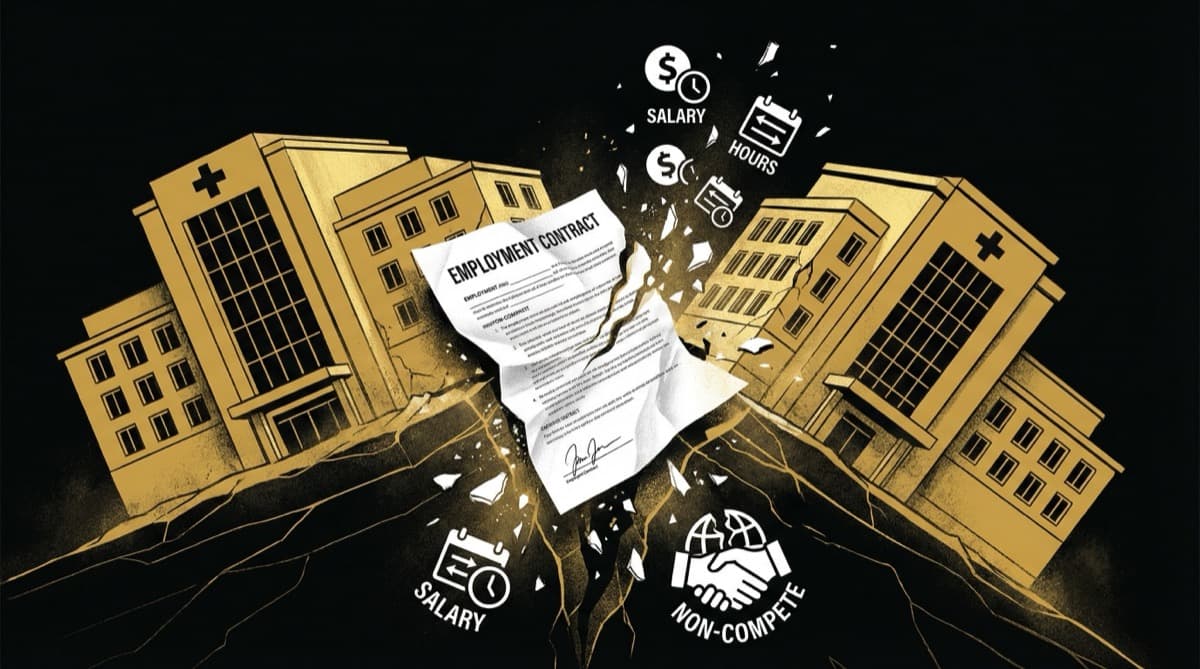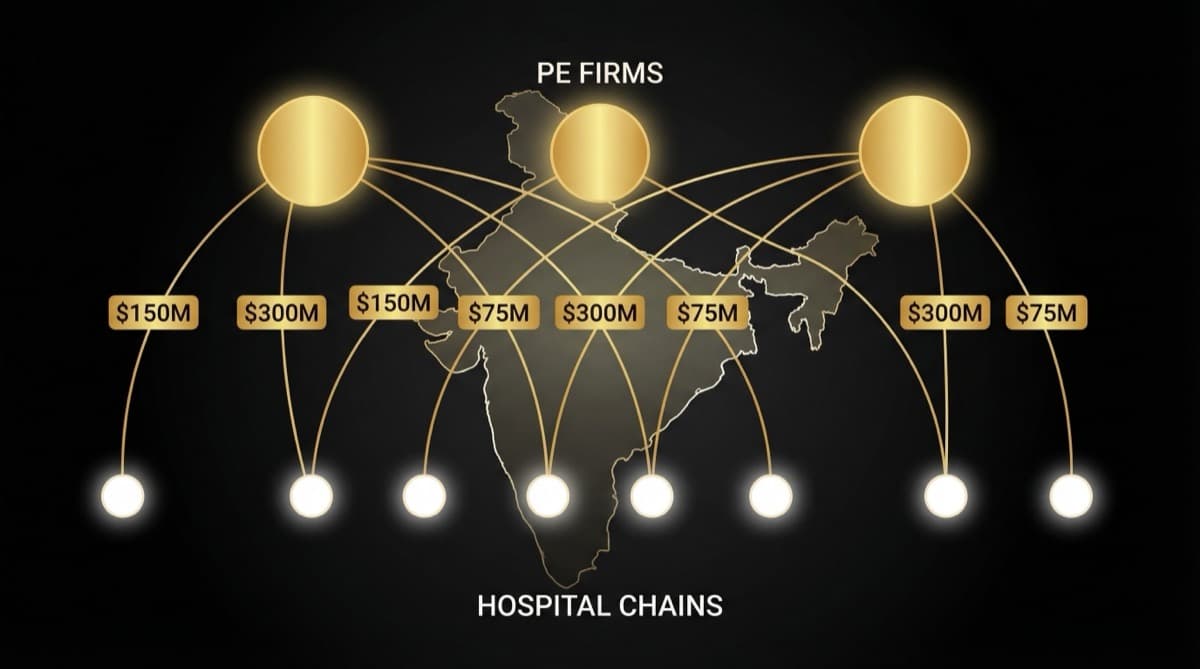
When private equity firms acquire hospitals in India, doctor compensation typically shifts from revenue-share models (where consultants earn 30-60% of billings) to fixed salary plus throughput-based incentives. The result: doctors do the same clinical work — often more of it — for less total compensation, while hospital EBITDA margins can nearly triple. Between 2022 and 2024, PE firms invested $4.96 billion in Indian hospital acquisitions, making this the single largest structural force reshaping how doctors get paid.
Why Does Private Equity in Indian Hospitals Matter Right Now?
It matters because India is in the middle of the largest private equity takeover of hospitals in its history.
Blackstone acquired Care Hospitals and KIMS Health for ~$1 billion in 2023, creating a 23-hospital, 4,000-bed platform across 11 cities. Temasek bought a 59% controlling stake in Manipal Health Enterprises for $2 billion, giving it control over 29 hospitals, 8,300+ beds, and 4,000+ doctors. KKR exited Max Healthcare in 2022 with a 5x return after dramatically restructuring its operations. CVC Capital sold its 54% stake in Healthcare Global Enterprises (HCG) to KKR for $400 million in 2024.
These are not passive investments. PE firms restructure how hospitals operate — and the first lever they pull is doctor compensation.
How Does Doctor Compensation Work Before PE Acquisition?
Before a PE acquisition, most Indian hospitals — especially mid-size chains and single-specialty centres — compensate senior consultants through revenue-sharing models.
Here's how the typical pre-acquisition model works:
Revenue-Share | Consultant receives 30-60% of billings generated from their patients Split by Specialty | Highly specialized services: 60-70% to doctor. Routine consultations: 50/50 split OPD Fees | Doctor often keeps 60-80% of outpatient consultation fees Volume Upside | More patients = proportionally more income. No ceiling Hospital's Share | Hospital retains 30-40% to cover infrastructure, admin, and nursing costs
In this model, a senior cardiologist performing 15 procedures a month might earn Rs 8-15 lakhs, with income directly tied to clinical output. The doctor has pricing influence, scheduling autonomy, and a direct financial relationship with their patient volume.
This model creates high-earning doctors — but from a PE firm's perspective, it creates unpredictable costs that eat directly into EBITDA margins.
What Is the Three-Phase Compensation Shift After PE Acquisition?
Doctor compensation changes in three predictable phases after PE acquisition. Phase 1: The "Nothing Changes" Period (Months 0-6)
Immediately after acquisition, PE firms almost always promise continuity. Doctor contracts are honoured. Revenue-share arrangements continue. The message is: "We're here to invest, not disrupt."
This is strategic. PE firms need doctors to stay — patient volume is the asset they just paid billions for. Doctor attrition during transition would destroy the acquisition thesis.
Phase 2: The Restructuring (Months 6-18)
Once operations stabilize, the restructuring begins. The core move is shifting consultants from revenue-share to fixed salary plus performance bonuses tied to throughput metrics.
Here's what actually changes:
Revenue-share: 30-60% of billings | Fixed salary: Rs 2-5 lakhs/month + incentive bonuses Income scales with patient volume | Income caps at target thresholds Doctor negotiates individual terms | Standardized compensation bands Scheduling autonomy | Hospital-managed scheduling for bed optimization Clinical freedom on procedures | Protocol-driven pathways and package rates
The data from KKR's Max Healthcare restructuring illustrates this clearly: the hospital chain's EBITDA margin rose from 9.7% in FY2019 to 27.2% by FY2022. Key strategies included "reduced minimum guarantees in doctor fees" and "aligning staff strength to occupancy levels" — corporate language for paying doctors less per unit of work.
Phase 3: The New Normal (Month 18+)
By this stage, the compensation structure is fully reset. Doctors who accepted the new terms are on standardized contracts. Those who didn't have left — and been replaced.
The replacement pattern is critical: PE-backed hospitals increasingly hire younger, lower-cost specialists to fill senior consultant departures. A senior surgeon earning Rs 12 lakhs/month in revenue-share is replaced by two junior consultants at Rs 3-4 lakhs each — same bed utilization, half the doctor cost.
What Is the EBITDA Math That Drives Every PE Decision?
Private equity firms don't think in terms of doctor salaries — they think in terms of EBITDA multiples. And doctor compensation is the single largest controllable cost in a hospital.
Here's the structural math:
- Staff costs (primarily doctor fees and salaries) represent approximately 50% of a hospital's total operational costs
- PE firms typically acquire hospitals at 15-20x EBITDA and target exit at 20-25x EBITDA
- Every 1% reduction in staff cost-to-revenue ratio translates directly to EBITDA margin improvement
- At a hospital doing Rs 500 crore in revenue, a 5% margin improvement = Rs 25 crore additional EBITDA = Rs 375-500 crore in additional enterprise value at exit
This is why KKR earned a 5x return on Max Healthcare in just four years. The investment was Rs 1,844 crore; the exit was over Rs 9,000 crore. That delta came primarily from operational restructuring — and doctor compensation was a central part of it.
What Specifically Changes in Your Contract After PE Acquisition?
If you're a doctor at a hospital that gets acquired by PE, here are the specific contract changes to watch for:
- 1Revenue-Share Becomes Fixed + Variable
Your 40% revenue-share becomes a Rs 3 lakh fixed salary plus "performance bonuses" tied to hospital-defined metrics — not your billings, but bed occupancy, discharge rates, and patient throughput.
- 1Non-Compete Clauses Get Tighter
PE firms protect their investment by restricting doctors from practicing within a certain radius (often 10-15 km) for 1-2 years after leaving. In India, these clauses have limited enforceability, but the chilling effect is real.
- 1Throughput Metrics Replace Clinical Freedom
Instead of choosing how many patients to see, the hospital schedules you based on bed optimization algorithms. Your "productivity" is measured in ARPOB (Average Revenue Per Occupied Bed), not clinical outcomes.
- 1Package Rates Replace Fee-for-Service
Procedures get bundled into standardized packages. The surgeon who charged individually for consultations, procedures, and follow-ups now operates within a fixed package rate — often lower than their previous per-procedure billing.
- 1Administrative Layers Increase
Decisions about equipment purchase, staffing, scheduling, and even treatment protocols increasingly flow through non-clinical administrators focused on financial metrics.
What Do the Numbers Tell Us About PE Impact on Hospitals?
The data reveals dramatic shifts. Max Healthcare EBITDA margin | 9.7% (FY2019) | 27.2% (FY2022) | Max Healthcare annual reports PE investment in Indian hospitals (2022-2024) | — | $4.96 billion | Bain India Healthcare PE Report 2024 Total PE/VC healthcare inflows (5 years) | — | $15.5 billion | Medical Buyer / Bain Report KKR return on Max Healthcare | Rs 1,844 Cr invested | Rs 9,185 Cr exit (5x) | Business Standard Blackstone hospital platform | — | 23 hospitals, 4,000 beds | Franchise India / Digital Health News Temasek-Manipal deal | — | $2 billion, 29 hospitals, 8,300 beds | Business Today Aster-CARE-KIMS merged entity | — | $5 billion enterprise value, 38 hospitals | Digital Health News Hospitalization cost gap (private vs public, urban) | 3.1x (1986-87) | 8.0x (2017-18) | ScienceDirect / NSSO data
Who Benefits and Who Loses From PE Hospital Acquisitions?
PE firms benefit — demonstrably. A 5x return in 4 years (KKR/Max) sets the benchmark.
Hospital infrastructure benefits — PE capital funds expansion, upgrades, and technology adoption, especially in tier 2 and tier 3 cities.
Patients get mixed results — better facilities and technology, but higher costs. Private hospital costs have risen from 3.1x to 8.0x of public hospital costs in urban areas over three decades.
Senior consultants lose the most — they built practices on revenue-share models. The shift to fixed salary with throughput incentives caps their upside while maintaining or increasing their clinical workload.
Junior doctors face a paradox — more jobs available (PE funds expansion), but starting salaries remain frozen at Rs 40,000-90,000/month in private hospitals. The expanded capacity creates positions, but the compensation structure is designed for margin, not talent.
What Does the PE Wave Mean for You as a Doctor?
If you're a doctor in India today, the PE wave is not a distant financial story — it's the structural force most likely to change your compensation in the next 5 years.
Three things to understand:
First, if your hospital is PE-backed (or about to be acquired), your revenue-share arrangement has an expiration date. Start calculating what your income looks like under a fixed-salary model.
Second, the doctors who maintain income after PE acquisition are those with patient relationships the hospital can't replace. If patients come for you specifically — not for the hospital brand — you have leverage. If they come for the hospital, you're replaceable.
Third, this is a structural shift, not a cyclical one. PE investment in Indian healthcare hit $5.5 billion in 2023 alone — a 25% increase year-over-year. This capital demands returns, and those returns come from operational efficiency. Doctor compensation is the largest line item.
Frequently Asked Questions
Do all PE-backed hospitals cut doctor salaries? Not immediately, and not always through direct salary cuts. The mechanism is subtler: revenue-share models are replaced with fixed salary plus incentive structures that cap total compensation. The effect is a 20-35% reduction in total earnings for senior consultants over 12-18 months, though the hospital can truthfully say "we haven't cut anyone's salary."
Can I negotiate better terms with a PE-backed hospital? Yes, but your leverage depends on one thing: patient stickiness. If you bring patients who follow you regardless of hospital brand, you can negotiate. If your patients are hospital-sourced (through the brand's marketing, aggregator platforms, or insurance panels), the hospital has the leverage.
Should I leave if my hospital gets acquired by PE? Not necessarily. Evaluate: (1) what percentage of your income comes from revenue-share vs. fixed salary, (2) whether you have a patient base that would follow you to another setup, and (3) whether you're in a specialty where demand exceeds supply in your geography. If all three favour you, you have options. If not, staying and adapting may be the pragmatic choice.
Are PE-backed hospitals better or worse for patients? Both. Infrastructure, technology, and standardized protocols improve. But costs rise — private hospital costs have grown to 8x public hospital costs in urban areas. And the pressure on doctor throughput can reduce consultation time and clinical attention per patient.
Which PE firms own hospitals in India? As of 2026, the major players are: Blackstone (Care Hospitals + KIMS Health + Aster DM), Temasek (Manipal Health Enterprises), KKR (Healthcare Global / HCG, Baby Memorial Hospital), and the recently merged Aster-CARE-KIMS platform valued at $5 billion.
futurise. builds premium healthcare brands in 48 hours. Learn more at futurise.studio