On this page
Pharmaceutical companies in India spend an estimated Rs 50,000-70,000 crore annually on doctor engagement — from medical representative visits to conference sponsorships to branded generic promotions. This isn't corruption — it's a structural incentive architecture where pharma companies invest in influencing prescription behavior because the economics work: a Rs 500 gift generates thousands in branded generic prescriptions. When a doctor writes "Brand X" instead of "generic equivalent," the decision is shaped by a system of margin structures, relationship economics, and information asymmetry that most patients never see.
The Prescription Influence Chain
Q.What Is Level 1: Medical Representatives (MRs)?
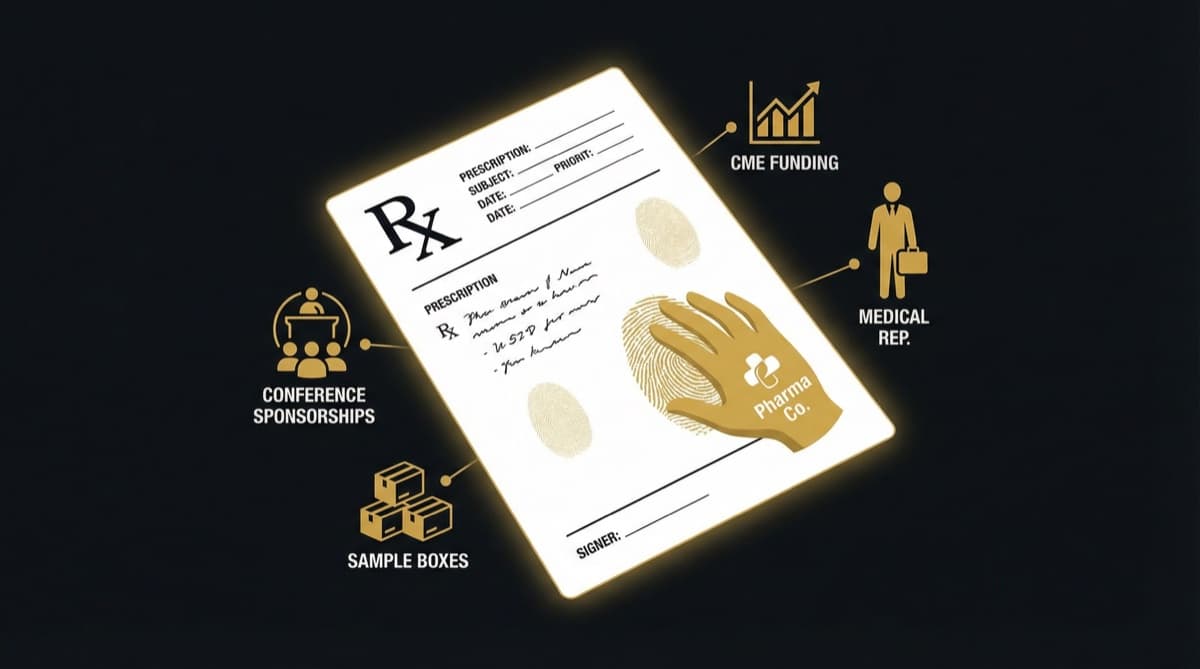
India has approximately 5-6 lakh medical representatives — one of the world's largest pharma field forces. Each MR covers 8-12 doctors per day, visiting each doctor's clinic with product samples, clinical data, and branded promotional materials.
What MRs actually do:
- Present clinical data (often selectively) about their company's products
- Provide free samples that introduce doctors to their brands
- Track prescription patterns through chemist audits
- Offer gifts within (and sometimes outside) the Uniform Code of Pharmaceutical Marketing Practices (UCPMP)
- Build personal relationships that create prescribing loyalty
The structural economics: An MR costs the pharma company Rs 4-8 lakhs/year (salary + travel + expenses). If that MR influences a doctor to prescribe their brand for 20 patients/month at Rs 500 margin per prescription, the annual return is Rs 1.2 lakhs per doctor. One MR covering 10 doctors generates Rs 12 lakhs in prescription value — paying for themselves 1.5-3x over.
Q.What Is Level 2: Conference Sponsorships and CME?
Medical conferences, CME programs, workshops, and symposia are heavily pharma-funded. Registration fees, travel, accommodation, and speaker fees for hundreds of medical events annually come from pharmaceutical companies.
The mechanism: Sponsoring a conference isn't direct quid pro quo — it's brand association. When Pharma Company X sponsors the annual cardiology conference and their products are featured in satellite symposia, attending cardiologists develop brand familiarity that translates to prescription preference. The investment is Rs 10-50 lakhs per event; the prescription influence extends to hundreds of doctors.
NMC's proposed 2023 rules would have prohibited pharma conference sponsorship entirely. These rules are currently on hold — illustrating the political difficulty of dismantling a system that funds most of India's medical education infrastructure.
Q.What Is Level 3: Branded Generics Market Structure?
India's pharmaceutical market is dominated by branded generics — generic formulations sold under brand names. The same molecule (e.g., Atorvastatin) is available from 50+ manufacturers at prices ranging from Rs 2-15 per tablet.
Why doctors prescribe brands instead of generics:
Quality perception: Doctors (and patients) perceive branded generics from established companies as more reliable than unbranded generics from unknown manufacturers — a perception that has some basis in India's variable drug quality landscape.
Pharma relationship: The brand most familiar to the doctor (through MR visits, samples, conferences) gets prescribed.
Margin structure: Some pharmacy arrangements incentivize specific brands — creating a chain from manufacturer to doctor to pharmacist.
Need help with this?
Our team specializes in healthcare branding. Get personalized advice in a free 15-minute call.
Book a free 15-minute callQ.What Is Structural Economics: Why This System Persists?
For Pharma Companies: Branded generic marketing is the primary revenue driver. In India's Rs 2+ lakh crore pharmaceutical market, the difference between a 30% market share brand and a 5% market share brand for the same molecule can be Rs 500-1,000 crore in annual revenue. This makes doctor engagement the highest-ROI investment in pharma.
For Doctors: Pharma engagement provides: continuing medical education (often pharma-funded CME is the only accessible CME), clinical information about new drugs and formulations, practice-building support (patient education materials), and — though NMC prohibits it — financial incentives in various forms.
For Patients: Patients generally pay more for branded generics than they would for unbranded alternatives. A branded Atorvastatin at Rs 12/tablet vs. an equally effective unbranded generic at Rs 3/tablet means the patient pays Rs 270/month more — multiplied across multiple medications and millions of patients.
For the System: The pharma-doctor engagement model funds most of India's post-graduation medical education ecosystem. Without pharma sponsorship, many conferences, workshops, and CME programs wouldn't exist in their current form. This creates a dependency that makes structural reform politically and practically difficult.
Q.What's Changing: Digital Detailing and Direct-to-Patient?
Digital detailing: Pharma companies increasingly use digital platforms (email, apps, virtual meetings) to reach doctors, reducing dependence on physical MR visits. This is more cost-efficient and scalable.
Direct-to-patient marketing: Health awareness campaigns, patient education platforms, and branded health content reach patients directly — creating demand that influences doctors indirectly.
AI-driven targeting: Pharma companies use prescription data analytics and AI to identify which doctors are most likely to switch brands, targeting engagement resources more precisely.
MR workforce reduction: India's pharma MR workforce has been shrinking as companies optimize field force efficiency through digital channels. This trend accelerated post-COVID and continues.
Frequently Asked Questions
Q: Do pharma companies control what doctors prescribe?
A: Not directly — doctors retain prescribing autonomy. But the incentive architecture (MR visits, branded promotions, conference sponsorships, sample distribution) systematically biases prescription choices toward brands that invest in doctor engagement. The influence is structural, not coercive.
Q: Is it illegal for doctors to accept gifts from pharma companies?
A: The NMC's 2023 regulations (currently on hold) would have prohibited gifts, hospitality, and grants from pharma companies. The 2002 Ethics Regulations prohibit "unethical inducements." The UCPMP (Uniform Code of Pharmaceutical Marketing Practices) is voluntary, not legally binding. In practice, enforcement is minimal.
Q: Why don't doctors prescribe generic medicines?
A: Several structural reasons: quality variability in India's generic market (real concern, not just perception), pharma company influence on prescription habits, patient expectations of branded medicines, and lack of independent comparative data on generic equivalence.
Q: How does this affect patient costs?
A: Significantly. Branded generics cost 2-5x more than unbranded equivalents for the same molecule. For patients on multiple chronic medications, the annual cost difference can be Rs 10,000-50,000.
Q: What can doctors do about pharma influence?
A: Prescribe by generic name when possible. Evaluate clinical data independently (not from company-sponsored sources alone). Attend pharma-independent CME. Disclose conflicts of interest to patients. And recognize that the system is structural — individual awareness helps, but structural reform (enforceable generic prescription mandates, independent CME funding) is the real solution.
futurise. builds premium healthcare brands in 48 hours. Learn more at futurise.studio