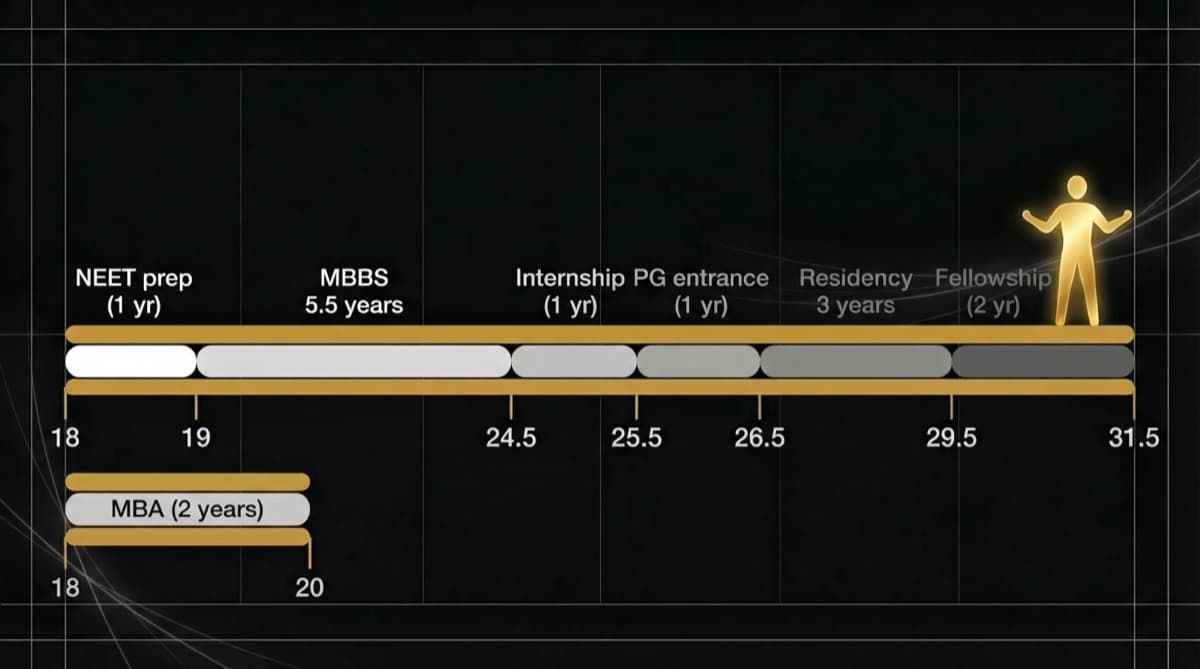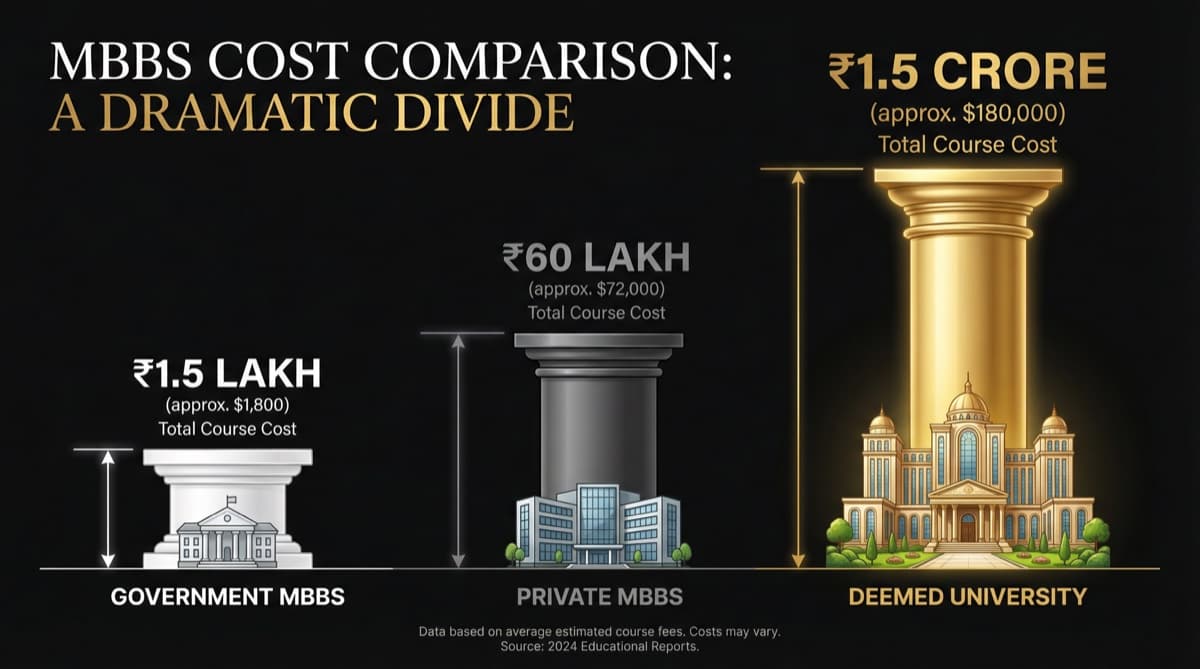
MBBS in India costs anywhere from Rs 50,000/year at a government medical college to Rs 30 lakhs/year at a deemed university — a 50x difference for the same degree, same curriculum, and same job market. A government MBBS costs Rs 50,000-5 lakhs total. A private MBBS costs Rs 55 lakhs-1.4 crore. A deemed university MBBS costs Rs 80 lakhs-1.65 crore. All three graduates write the same licensing exam, hold the same degree, and compete for the same Rs 40-90K/month starting positions. Here's the complete cost breakdown that every medical aspirant and parent needs before making a Rs 1 crore+ decision.
What Is the Total Cost Comparison Across All Institution Types?
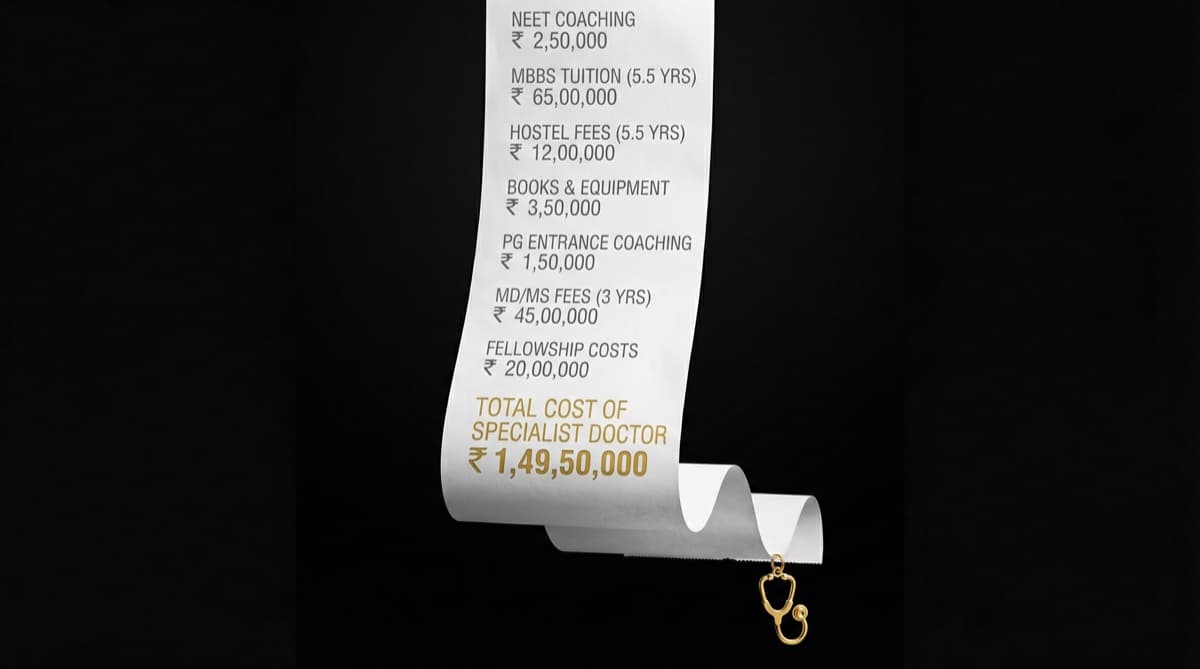
Here are the all-in numbers including every expense category. Tuition fees (5.5 years) | Rs 50K-5 lakhs | Rs 55 lakhs-1.4 crore | Rs 80 lakhs-1.65 crore Hostel & Accommodation | Rs 3-6 lakhs | Rs 5-10 lakhs | Rs 6-12 lakhs Food & Living | Rs 3-5 lakhs | Rs 4-7 lakhs | Rs 5-8 lakhs Books & Materials | Rs 1-2 lakhs | Rs 1-3 lakhs | Rs 1-3 lakhs NEET Coaching (pre-entry) | Rs 1-5 lakhs | Rs 1-5 lakhs | Rs 1-5 lakhs Miscellaneous | Rs 2-4 lakhs | Rs 3-5 lakhs | Rs 3-5 lakhs Total Direct Cost | Rs 10-22 lakhs | Rs 69 lakhs-1.7 crore | Rs 96 lakhs-2 crore Opportunity Cost (5.5 years) | Rs 15-25 lakhs | Rs 15-25 lakhs | Rs 15-25 lakhs GRAND TOTAL | Rs 25-47 lakhs | Rs 84 lakhs-1.95 crore | Rs 1.1-2.25 crore
What Does the Government Medical College Path Cost?
Government colleges offer the most affordable route to an MBBS. Fee Structure Government medical colleges charge Rs 10,000-1,00,000/year for general category students. At AIIMS, the annual fee is approximately Rs 6,750 — one of the most affordable medical educations in the world.
State government colleges vary: Rs 15,000-50,000/year in many states (Tamil Nadu, Rajasthan, UP), up to Rs 1 lakh/year in some (Maharashtra, Karnataka).
The Real Cost Beyond Fees Fees are subsidized but living isn't free. Hostel fees, food, books, transport, and personal expenses add Rs 50,000-1,00,000/month in metropolitan cities and Rs 30,000-50,000/month in smaller towns.
Why It's Hard to Get In Approximately 47,000 government MBBS seats for 20+ lakh NEET applicants. A student needs to be in roughly the top 3-4% of NEET takers to secure a government seat. This is the primary bottleneck — not the cost, but the competitive entry.
The Hidden Subsidy Government medical education is taxpayer-subsidized. The actual cost of training an MBBS doctor (infrastructure, faculty salaries, hospital operations) is estimated at Rs 30-50 lakhs per student over 5.5 years. The student pays Rs 3-5 lakhs. Taxpayers cover the rest.
This creates a social obligation argument for government medical graduates to serve in public healthcare — which some states enforce through service bonds.
What Does the Private Medical College Path Cost?
Private colleges charge market rates that create significant financial burden. Fee Structure Private medical colleges charge Rs 10-25 lakhs/year for MBBS. Fees vary based on:
- State fee regulation: Some states have fee regulatory committees that cap private medical fees. Others don't
- Management quota vs merit quota: Management quota seats cost more (often 2-3x the merit fee)
- College reputation and location: Established private colleges in metros charge more
- "Donations" and hidden fees: Some colleges charge unofficial amounts beyond the declared fee structure
The Loan Burden Most private medical students take education loans:
- Loan amount: Rs 40-80 lakhs
- Interest rate: 8-12% per annum
- Repayment period: 10-15 years post-graduation
- Monthly EMI (Rs 60L loan at 10%): ~Rs 79,000/month
This EMI burden begins during or shortly after MBBS — when starting salary is Rs 40-90K/month. Many graduates find their entire salary consumed by EMI payments.
What You Get for the Premium Private colleges offer some advantages: smaller batch sizes (sometimes), better physical infrastructure, and metro locations. However, the clinical training quality depends entirely on the teaching hospital's patient volume — which is often lower than government hospitals.
What You Don't Get A salary premium. The market doesn't pay private college graduates more. The Rs 1 crore+ premium buys access to the degree, not better career outcomes.
What Does the Deemed University Path Cost?
Deemed universities represent the highest tier of MBBS education costs. Fee Structure Deemed universities (like Manipal, SRM, MAHE, Amrita) charge Rs 15-30 lakhs/year — the highest tier of MBBS education costs.
What Justifies the Premium Some deemed universities offer genuinely superior infrastructure: modern simulation labs, international exchange programs, research opportunities, and well-equipped teaching hospitals. Top deemed universities (Manipal, MAHE, Kasturba) have established clinical training reputations that justify — partially — the higher fees.
What Doesn't Justify It Starting salary remains Rs 40-90K/month. The degree says "MBBS," not "MBBS (Deemed University)." For PG entrance (NEET PG), all MBBS graduates compete equally regardless of undergraduate institution. The brand name helps with recommendations and networking — but it doesn't change the salary structure.
What ROI Calculation Must Parents Do Before Choosing a Medical College?
The returns differ dramatically by institution type. Government MBBS ROI
- Investment: Rs 25-47 lakhs (all-in)
- Starting income: Rs 5-10 LPA
- 25-year career earnings (median specialist): Rs 10-20 crore
- ROI: 20-40x investment
Private MBBS ROI
- Investment: Rs 84 lakhs-1.95 crore (all-in)
- Starting income: Rs 5-10 LPA (same)
- 25-year career earnings (median specialist): Rs 10-20 crore (same)
- ROI: 5-12x investment
Deemed University MBBS ROI
- Investment: Rs 1.1-2.25 crore (all-in)
- Starting income: Rs 5-10 LPA (same)
- 25-year career earnings (median specialist): Rs 10-20 crore (same)
- ROI: 4-9x investment
The math is clear: Government MBBS delivers 3-4x better ROI than private or deemed alternatives — simply because the starting point is lower while the destination is the same.
Frequently Asked Questions
How much does MBBS cost in India in 2026? Rs 50,000/year at government colleges (Rs 50K-5 lakhs total) to Rs 30 lakhs/year at deemed universities (Rs 80 lakhs-1.65 crore total). Including living expenses and opportunity cost, the all-in range is Rs 25 lakhs (government) to Rs 2.25 crore (deemed university).
Is private medical college worth the cost? On pure financial ROI: usually not. The starting salary and career trajectory are identical to government college graduates. Private college is "worth it" only if the alternative is abandoning medicine entirely — and if the family has honestly assessed the debt burden.
Which state has the cheapest private MBBS? Fee regulation varies by state. States with active fee regulatory committees (like Tamil Nadu, Karnataka) tend to have lower regulated fees. States without effective regulation see higher fees. Check state-specific fee regulatory committee data for current caps.
Can I get scholarships for MBBS? Government colleges offer fee waivers for economically disadvantaged students. Some private colleges offer merit scholarships (5-15% fee reduction) for top NEET scorers. National scholarships (Post-Matric Scholarship, AICTE scholarships) provide limited financial support. However, scholarships rarely cover the full cost of private medical education.
Should I study MBBS abroad if Indian private college fees are so high? MBBS abroad (Russia, China, Philippines, Georgia) costs Rs 20-50 lakhs total — cheaper than Indian private colleges. However, graduates must pass the Foreign Medical Graduate Examination (FMGE) to practice in India, with pass rates historically around 20-25%. The risk-adjusted ROI must account for this significant exam barrier.
futurise. builds premium healthcare brands in 48 hours. Learn more at futurise.studio